Ghost Word
The clue was a good one, and Nerys Fenn resented it, because a good clue on a Saturday meant the whole morning gone before she reached the garden.
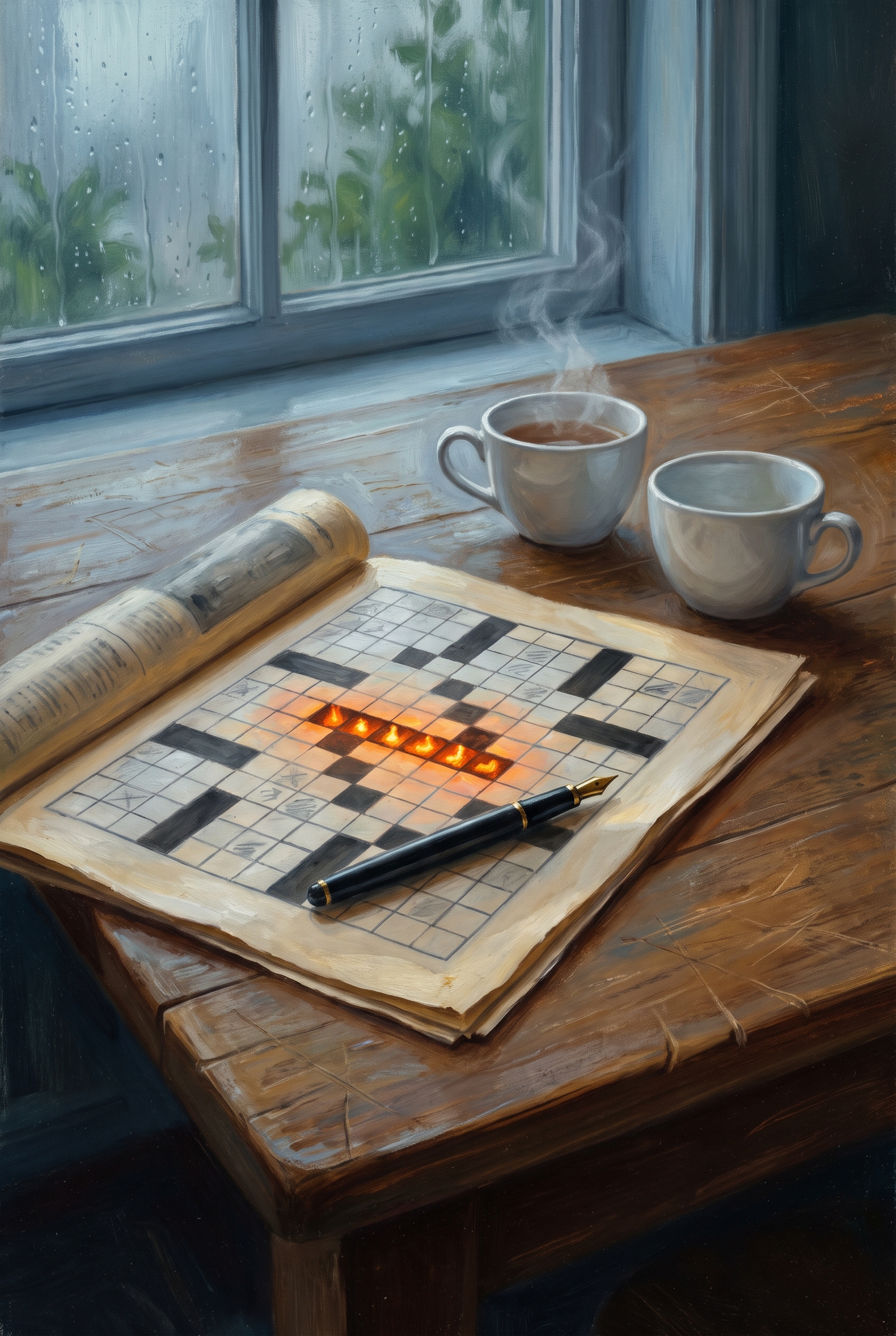
Synopsis — Ghost Word
Nerys Fenn, seventy-four, is a retired lexicographer who still solves the cryptic crossword in her small English town's weekly paper, set for eleven years by a stranger who signs himself Colophon. One Saturday an anagram resolves to sember — a word that exists in no dictionary on earth except one, because Nerys invented it. In the winter of 1974, grieving a woman named Marta whom she was never permitted to openly love, she coined sember ("the sense that someone gone is about to enter a room they once frequented") and hid it in the dictionary she was building as a mountweazel: a fake word planted to catch plagiarists. She never told a soul. So how has it surfaced, decades later, in a crossword grid?
Following the word, Nerys learns that Colophon has just died. He was Walter Sax, a hand compositor who set the type for her dictionary in the 1970s — the one man alive who ever read her false word, letter by backward letter, and carried it for forty years without knowing who wrote it. Going through his back catalogue she finds he had quietly seeded her invented words into his puzzles for years, a lamp left in the window every second Saturday for the author to notice. She never did, because looking at sember squarely was a thing she had trained herself for fifty years not to do. A folder marked For the one who comes asking after SEMBER holds his confession: two winters ago he worked out, from a correction she once mailed the paper, that the retired lexicographer doing his Saturdays was her — and chose to say so only in the one language they shared, a clue, rather than trespass on her grief in person. Widowed of a game she never knew she was playing, Nerys takes up the setter's pen herself, adopts the pseudonym Threshold to answer his Colophon, and sets her first crossword — leaving the word plain this time, and the door wide. A quiet story about private grief, the words we invent when the real ones are forbidden, and two people who met inside a single made-up word and missed each other by a decade of Saturdays.
Ghost Word
Story
The clue was a good one, and Nerys Fenn resented it, because a good clue on a Saturday meant the whole morning gone before she reached the garden.
She had the paper folded to its quarter, the pen uncapped, the tea at the exact heat she liked and would not stay at for long. Colophon had set the crossword in the Larchmoor Advertiser every week for eleven years, and in eleven years he had never once let her finish before the kettle cooled twice. She had come to think of him the way you think of a neighbour whose face you have never seen: only his handwriting, only his turns of mind, fond and a little cross and glad on Saturdays.
Embers, stirred, and still she keeps the door ajar (6).
An anagram, plainly. "Stirred" did the stirring; "embers" was the fodder; the rest was a definition she would recognise once she had the letters. She wrote them small in the white squares, the way she had written since 1961, when a chief editor with ink dried into the grain of his knuckles had told her that a girl who could not fit antidisestablishmentarianism into a two-em margin had no business near a dictionary. She turned the fodder over from the back, the way she turned everything over, and the six letters fell into place before she had given them leave.
S. E. M. B. E. R.
Outside, a wood pigeon said its five soft notes, then said them again, in case she had missed the point.
She did not write the answer in.
There was no such word. She knew it the way you know the plan of your own house in the dark, without lights and without argument. Sember was not in Larchmoor's. It was not in Chambers, not in the great Oxford, not in Wright's dialect dictionary, all six brown volumes of it, which she still owned and on bad nights still read. It lived in one book only, and she was the reason.
She could recite the entry because she had made it, at a slope-topped desk in a cold room above the Larchmoor Press, in the winter of 1974, when she was twenty-two and had lately learned that some absences do not go anywhere. They only change address.
sember, n. rare. The sense that a person no longer in a place is nonetheless about to enter it; the felt nearness of one who is gone. [Origin obscure; perh. f. dial. semble to seem.] And then, because a proper entry wants a proper witness, she had forged one: 1903 E. Harkness Fenland Airs 41 "I set two cups, from sember, and drank the both."
A mountweazel, the trade called it, though the trade could never agree on why. Every serious dictionary carries a few. False words, salted quietly into the columns, so that if a rival copies your work wholesale the fake surfaces in their pages like dye in a river and proves the theft. You are meant to choose something forgettable. A hamlet that isn't there. A knot no sailor ties. You are not meant to choose a word you need.
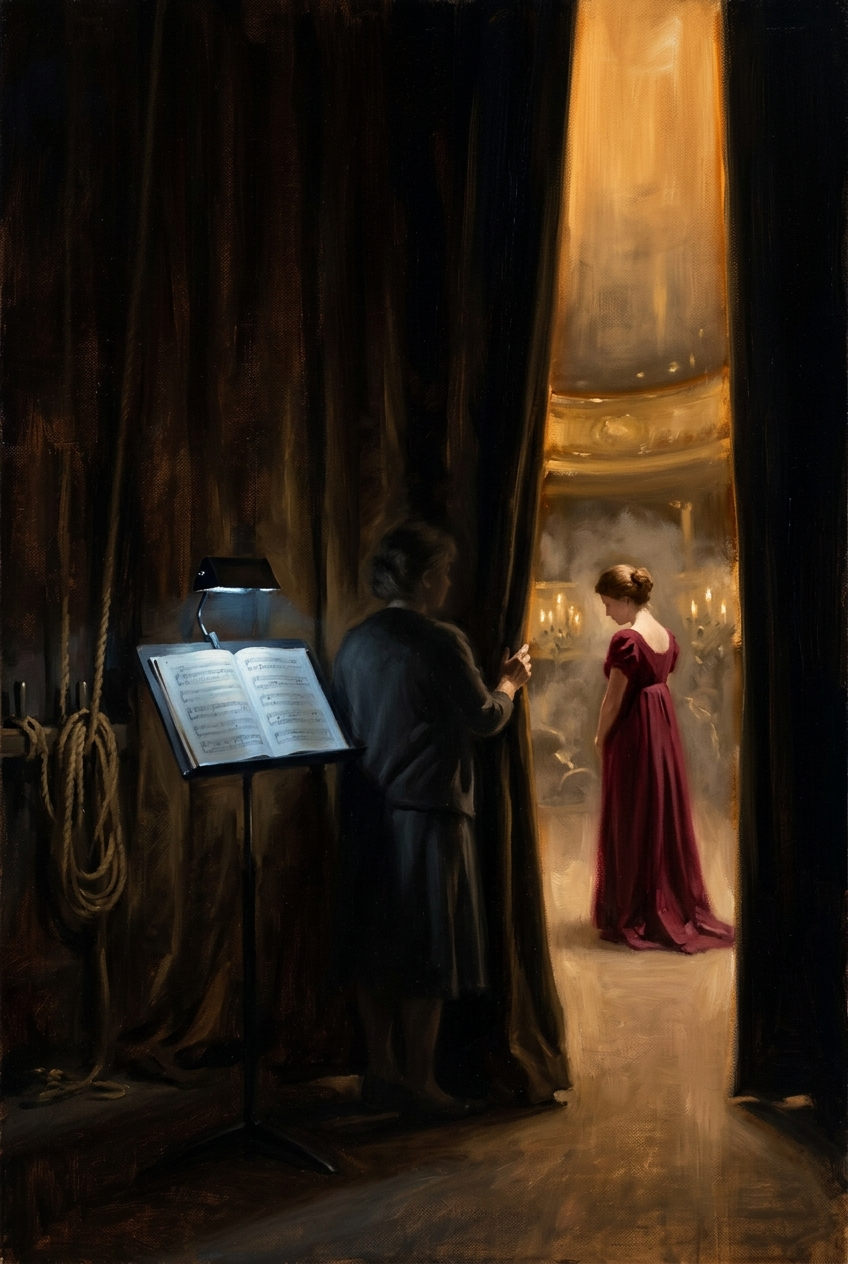
Marta Sole had bound the review copies in the room below, and had a way of coming up the iron stair two at a time so the whole press knew that joy was on its way. In the March of that year she had gone to Lincoln to be married to a man with a dry-goods shop, and had not come up the stair again. For a month afterward Nerys had felt her about to. She would look up from the proofs at nothing, certain, in the half second before certainty failed, that the door was going to open. That was the whole of it. There was no word for a person you had not been permitted to miss, so Nerys, who spent her days deciding what words meant, made one, and gave it the driest face she could manage, and hid it in the S's where it would live unread forever, safe as a letter never sent.
Only now it was in the paper. In Colophon's grid. In his small even clues, on an ordinary Saturday, fifty years on.
She capped the pen. The garden could keep.
The Advertiser lived over the chemist in two rooms that smelled of toner and old radiator. Nerys had never climbed the stairs. In eleven years she had corrected the setter twice, both times by letter: once about a loose anagram, once about a homophone that only rhymed if you came from Hull. Both times a slip had come back in the following week's post, unsigned, conceding the point with a grace that had made her, absurdly, proud.
The editor was a young woman named Prisha Rao, who seemed to run the whole paper with a phone in one hand, and who looked up at Nerys with the braced patience of someone expecting a complaint about a bin collection.
"I've come about the crossword," Nerys said, and watched the patience change into something more careful.
"Ah." Prisha set the phone face down, which Nerys understood to be a courtesy on the order of removing a hat. "You'll have heard, then. I did wonder whether any of the regulars would."
"Heard what."
"He died. Colophon. Mr Sax." Prisha said the name gently, testing whether Nerys had owned the man or only his puzzles. "Walter Sax. Ten days ago now. We've a bank of his grids still to run, he was always weeks ahead of us, so it'll be a while yet before the paper goes quiet." She stopped. "I'm sorry. Were you friends?"
Sax. Nerys held the name the way you hold a stone lifted off a beach, waiting to feel whether it is only a stone.
"I didn't know him at all," she said, which was true, and felt like the largest lie she had told in years.
Prisha warmed, the way people do when the dead can still be handed to someone. "He was a printer, before he was ours. Before my time, before the paper went digital, before it went much of anything. He set type by hand. The little metal letters, the whole business. Forty years at the Larchmoor Press, he told me once, back when the Press still did the big books." She nodded at a framed thing on the wall, a foxed title page under glass. "We're printed out of Leicester now. He hated that."
The Larchmoor Press had done one big book. It had done it for ninety years and then it had stopped, and the building was flats with a bicycle chained in the porch. Nerys felt the cold room of 1974 assemble itself around her present feet. The slope desk. The stove that never reached the corners. And two floors down, past the room where Marta had bound the copies, the composing room, where a man she never met had stood at a case of type and picked out, letter by letter, backward and upside down, every word she wrote.
Every word. Including six she had invented.
"Could I see them," she said. "The grids he's left you. And the old ones, if you keep them."
Prisha kept them. Of course she kept them; a small paper keeps everything, in boxes, against the day someone asks. She brought one out from the back and set it on the counter and went to answer her phone, and left Nerys alone with eleven years of Saturdays.
There were perhaps two hundred grids, clipped in bundles by year, and his hand got smaller and more careful as the bundles came nearer the top, the way a hand does. She did not have to hunt. She had spent a working life learning to catch her own phrasing in another lexicographer's column, the tell of a borrowed definition, and there they were: her foundlings, scattered across a decade like a name called softly at the back of a crowd.
Sedgewake, in a grid from 2019, clued as the last light going off standing water, which was exactly what she had written it to mean. Selveden, twice, once in a Christmas puzzle. And sember, again and again, every year or two, always clued so as to circle the meaning without once touching it, the way you circle a grief in company.
She had solved every one of these. She had filled the squares in her small even letters and never once looked at what she was spelling, because to look at sember squarely was a thing she did not do, had trained herself across fifty years not to do. And so the one man in England who had been reaching for her had reached, week upon week, into a silence she was keeping on purpose.
At the bottom of the box, under the oldest bundle, there was a plain manila folder, and on it, in the small careful late hand, it said: For the one who comes asking after SEMBER.
She stood very still. Then she opened it, because she had never in her life been able to leave a word unread.
Inside was a single index card, and clipped to it a half sheet of paper, folded once. The paper first. It was in pencil, pressed hard, the letters a compositor's letters, upright and even and spaced as if for a caption.
I set your book. Volume S, the winter of '74 and the spring after it. A compositor reads a thing more times than its writer does, and he reads it backward, which is the honest direction. I read your false word about four hundred times, and I have carried it about forty years since. I never knew whose it was. A man doesn't, with an unsigned book. He only knows the hand had something in it that the hand wasn't saying.
Then two winters back the Advertiser had a letter putting me right on an anagram. Very kind, very certain. Signed N. Fenn. And I remembered the staff card from the Press: N. Fenn, assistant, second floor. I am slow but I am not a fool. So it was you upstairs the whole while, doing my Saturdays, and it had been you at the slope desk when I was down at the case, two floors and fifty years between us, and never a word said out loud that wasn't first set in metal.
I thought about knocking on your door. But a man who turns up to tell a woman he has been keeping her grief in a drawer is not a welcome man, whatever he means by it. So I did the only decent thing I know how to do, which is to set you a clue and let you come to it in your own time, the way you like to. Here it is. You will not need the enumeration.
She unclipped the card. On it, ruled off neat, was the clue.
Two cups, and the sense she has only stepped out (6).
No fodder to stir this time. No anagram, no charade, nothing hidden, nothing to solve but the plain sentence he had built out of her own forged citation, the two cups she had invented for a poet who never lived. He had given up the game at the end and simply said it. Six letters. She had always known them. She sat down on the visitor's chair by the counter, in a room that smelled of toner, and let the wood pigeon of fifty years finally land.
There was a term for the other kind of false word, she thought, the accidental kind. A ghost word: one that had never meant anything at all, born from a printer's slip or a scholar's misreading of a smudge, and yet printed, and yet solemnly copied on, real enough to walk the columns of better books than it deserved. She had made a false word on purpose. Walter Sax had spent forty years making it a ghost, keeping it walking, setting a lamp in its window every second Saturday for whoever might be out there in the dark to see. Between the two of them they had very nearly made the thing true.
Prisha came back off her phone and found the old woman still sitting there, and had the sense, which was rarer in the young than people said, not to ask.
"Nine weeks," she offered instead, to the middle distance. "That's what's left of him in the box. After that I've no setter and no budget for a setter, and the regulars will write in cross, and I'll have to run those dreadful syndicated grids out of a shed somewhere in Wiltshire, all quotations and film stars." She turned the phone over and over on the counter. "You corrected him twice in eleven years, and you were right both times. I don't suppose you'd know anyone."
Nerys was seventy-four. She had defined some sixty thousand words across her working life and confessed nothing whatever to anyone. She had built an entire language sooner than say one true sentence aloud, and here was a stranger with a telephone offering her the only pulpit she had ever coveted: a small grid of black and white squares, where a person could tell the truth sideways, and call it a puzzle, and no one would ever ask her to explain herself.
"I should want a pseudonym," she said.
"They all do."
She thought about it on the walk home, past the chemist, past the flats that had been the Press, along the towpath where the cold came up off the canal even in August. That evening she cleared the Saturday table of the tea things and the folded paper, and got down the graph paper she had kept for years for reasons she had declined to examine, and ruled a grid. Fifteen by fifteen. She built it outward from the middle, from one answer she set down first and would clue last, six letters lying across the very heart of it, and around that she began to make the rest. The easy charades. A hidden word tucked so neatly into an innocent phrase that some solver on some future Saturday would find it and feel, for the length of one breath, chosen.
She would coin a new word for the top left corner. There was as yet no word for two people who meet inside a false one and miss each other by a decade of Saturdays, but she knew exactly where such words came from, and she had the whole night, and the pen was already warm in her hand.
At the head of the sheet she wrote the name she would set under. Not Colophon. A colophon is the note at the very back of a book, the maker's small signature on the last leaf, the printer standing up at the end to say here is where I stood and here is when. It had suited him. He had come at the end of things, at the foot of the stair, after the marriage and after the Press had closed and after fifty years.
She wanted the other end of the book. The word for the way in.
She wrote Threshold, and under it she began to build the light for sember, the first clue she had ever set in her life, and this time she did not circle the word. She wrote it plain, and set two cups on the table out of an old habit she saw no more reason to break, and left the door wide.
More from Short Stories