Last Car Running
The Fury came off the trailer nose-first, dead as a church on Monday, and Dee let it roll until the front tires found the gravel and stopped it for her.
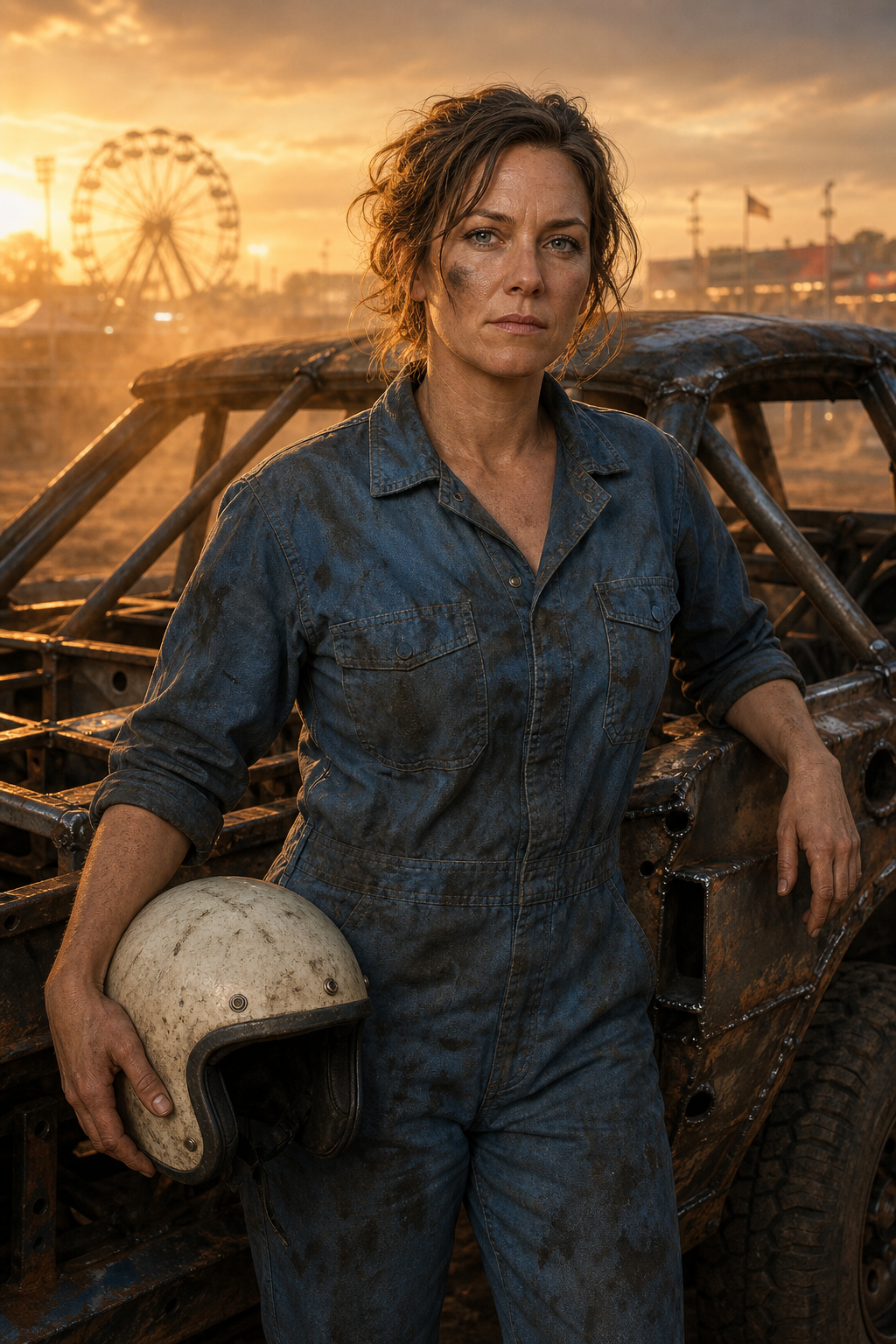
Synopsis
Dee Kowalczyk is the daughter who stayed. When her father Walt slips into dementia and, in a four-a.m. confession he won't remember, admits he "owes Fran a car" — a decades-old promise to his late derby-driver wife — Dee buys a junk '76 Plymouth Fury and spends eight days welding it into a demolition-derby machine before the Ostrander County Fair. In the trunk she finds a dead woman's helmet with the name FRAN checked in brown nail polish, and decides to run in it herself. On the fair's closing Saturday she wins the big heat and lays a victory lap of dust in front of the whole standing county while Walt, lucid for exactly as long as it lasts, watches from the second row. Afterward he asks, "Did Fran win?" — and Dee gives him the truest of the two true answers.
Last Car Running
Story
The Fury came off the trailer nose-first, dead as a church on Monday, and Dee let it roll until the front tires found the gravel and stopped it for her. Sixteen feet of Plymouth the color of pond scum. Somebody had spray-bombed a peace sign on the hood back when it still had a hood worth the trouble. Now it had this: rust blooming through the rocker panels like something growing, a cracked windshield she'd pull anyway, and a smell in the trunk she didn't want to name.
Her father stood in the barn door with his coffee and looked at it the way other men looked at a horse.
"There she is," Walt said.
"There she is," Dee agreed, because it was easier than the truth, which was that there she wasn't. The car her father wanted and the car sitting in his gravel were two different objects that happened to share a shape.
She'd found it through a guy who knew a guy, out past the county line where the farms gave up and turned into places that kept cars. Three hundred dollars and a case of beer she'd had to buy the man separately, on top, like a tip. The title was gone. Nobody who ran the derby cared about a title. What you cared about was the frame, and the frame on a '76 Fury was a bridge somebody'd decided to put wheels under. That was the whole appeal. You couldn't kill it with a sledgehammer, which was the point, since a sledgehammer was more or less what the derby was.
"Green Hornet," Walt said. He came off the door and put his hand flat on the fender, and something in his face went loose and young for a second. "You got her running by the fair, we'll show these people how it's done."
"That's the plan."
"Your mother's gonna want to run the Powder Puff."
Dee kept her eyes on the rust. This was the part she'd gotten good at, the not-looking, the letting it go by. "We'll see," she said.
Her mother had been dead eleven years.
The Ostrander County Fair ran the third week of August, same as it had since before Dee was a thought. Rabbits and pies on Tuesday. Tractor pull Thursday. The demolition derby closed it out Saturday night under the lights, and if you'd grown up in Ostrander you understood without being told that the pies and the rabbits and the tractors were the throat-clearing and the derby was the sentence.
Dee had a welder, a torch, a father, and eight days.
She started where you always started, gutting the car so it couldn't burn her alive. Out came the glass, the door panels, the carpet gone stiff and black, a mouse condominium she evicted with a shop vac and a lot of swearing. She chained the doors, welded the seams, moved the battery up into the cab and strapped it where the passenger's feet would go. She ran a fresh line to a boat tank because the factory tank was a bomb waiting on an excuse. She left maybe two gallons in it. You didn't need range. You needed to hit people.
Walt sat in a lawn chair in the barn and narrated a derby that had happened forty years ago.
"Sully ran a Wildcat that year," he said. "Big yellow thing. Everybody's scared of Sully 'cause Sully'd take your knees off, he didn't care, it's his brother-in-law out there he'd take his knees off too." He laughed, and the laugh turned into a cough, and the cough took a while. Dee watched him out of the corner of the mask, the arc throwing his shadow big and jumping on the barn wall.
"And Mom beat him," Dee said. She knew this story. She'd been raised inside this story.
"Your mother," Walt said, "put that Fury sideways in the last thirty seconds and stuffed Sully into the judge's stand so hard they had to move the judge." He shook his head, wondering at it all over again. "That's the night I asked her out. Right there in the mud. She's still got her helmet on, I can't even see her face, and I said, you want to get a beer, and she says—" He stopped.
"She says," Dee prompted, cutting the arc, lifting the mask.
Walt looked at her. For a second his face did the thing it had started doing this last year, the searching, the little animal panic behind the eyes when the floor of a familiar room wasn't where his foot expected it. Then it passed and he was just an old man in a lawn chair who'd lost the thread.
"You should ask her," he said. "She tells it better."
"Yeah," Dee said. "I will."
Her brother called Wednesday from Columbus. Kyle managed a store that sold mattresses and had opinions about their father he liked to deliver from ninety miles away.
"He can't be out there in that heat," Kyle said. "You've got him out there in that heat."
"He's in a chair in the shade drinking iced tea, Kyle, he's not laying pipe."
"You're not a nurse."
"No," Dee said. She was under the car when she said it, on her back on the creeper, and a fine rain of rust was coming down on her safety glasses, and she thought about all the things she was not. Not a nurse. Not a wife, not anymore. Not the one who'd left, that was Kyle, that was the whole architecture of the family in two syllables. She was the one who stayed. Staying didn't come with a title either.
"The doctor said routine and calm," Kyle said. "A derby isn't routine and calm."
"For us it is."
He was quiet, and she could hear the store behind him, the awful bright music of a place that sold sleep. "I'm just saying somebody should be realistic about where he's at," Kyle said. "He thinks Mom's alive. Barbara told me. He thinks she's coming to the fair."
Dee set the wrench down on her chest and looked up at the black underside of the car, the frame she'd spent two days making immortal.
"He doesn't think that," she said, which was a lie, and she knew it was a lie the way you know a tooth's going bad before it hurts, from the inside, from a place that had stopped asking your permission. "He just likes the story."
Here is what Dee had not told Kyle, or Barbara, or anyone.
Three weeks ago her father had come out to the barn at four in the morning. She only knew because she couldn't sleep either, hadn't slept right since the divorce, and she saw the barn light from the kitchen and went out barefoot across the cold gravel expecting a raccoon or a stroke. She found him standing in front of the empty bay where the Fury wasn't yet, in his good pants and no shirt, holding his wallet.
"I owe her a car," he said, when he saw Dee. He wasn't crying. That was the part that stayed with her. He said it like a man reading a bill. "I told her I'd have it ready and I never did. Every year I said next year. You don't—" His hands came up, the wallet in one of them, forty dollars and a library card and a photo of the four of them at somebody's confirmation. "You think there's more years than there are. And then it's just the ones you spent."
Dee had taken him back inside and made him toast he didn't eat. In the morning he didn't remember, or acted like he didn't, which with Walt were coming to be the same thing.
She'd bought the Fury that afternoon.
She told herself it was for the derby, and it was. She told herself a man got to have the thing he wanted before the wanting left him along with everything else, and that was true too. But under it, in the four-a.m. place, was the real reason, and the real reason was that her mother had died in a bed with tubes in her arm on a Tuesday afternoon, hairless, ninety-one pounds, nothing about her the way it should have been, and it had ruined something in Dee that she'd never gotten back. And her mother in the story was the opposite of that. In the story her mother had a helmet on so you couldn't see her face, and she put a two-ton Plymouth sideways in the mud on purpose, and she won.
Dee wanted to build that. Not the car. The other thing. The version where her mother won.
She got the Fury running Friday at dusk. It started ugly, caught, died, caught again, and then the big block turned over and settled into a lope that she felt in her sternum before she heard it. Walt was up out of the lawn chair faster than she'd seen him move in a year. He stood by the open driver's door with his hand on the roof and his head cocked, listening the way you'd listen to a baby breathe.
"Timing's a hair advanced," he said.
"Timing's fine, old man."
"Bring it back a hair, she'll pull cleaner off the corner. Your mother liked it advanced 'cause she liked the bark, but you want the pull." He said it plainly, technically, one mechanic to another, and it was the clearest he'd sounded in weeks. Dee brought the timing back a hair. It pulled cleaner off the corner. She didn't say anything. She didn't want to spook it.
In the trunk, when she'd cleaned it out that first day, she'd found the thing she hadn't told anyone about either. Wrapped in a feed sack, gone stiff, mouse-chewed at one strap: a helmet. Old, open-face, the paint checked and dull, and across the back in a woman's careful hand, in nail polish gone brown, a name. Not her mother's name. FRAN, it said, which was her mother, everybody called her Fran, but the fair had a rule and the rule was you painted your legal name on the car so they could tell your people who to come get, and her mother's legal name was Frances, and she'd hated it, and here on this helmet in a dead woman's nail polish it said FRAN, the name she picked, the name she answered to.
It wasn't the Fury's helmet. Couldn't be; different car, different life. Some other woman named Fran, some other August. Dee knew that. The rational floor of her held that fact up flat and steady.
She kept the helmet anyway. Set it on the shelf over the bench where she could see it. Told herself it was luck.
Saturday came in hot and stayed hot. Dee ran the Fury up onto the trailer at three and her father rode shotgun in the truck to the fairgrounds with his window down and his elbow out, wearing the good hat, the one for church and funerals, and Dee didn't tell him it was a derby not a church because you take the hat you're given.
The pits were the pits. Diesel and dust and forty guys who all knew each other, welders going, a kid with a leaf blower trying to keep the radiator clean on a Caprice, somebody's dog, somebody's cooler, the loudspeaker testing itself with a squeal that set every tooth on edge. Dee backed the Fury off the trailer and a couple of the older guys drifted over to look, because a '76 Fury still running was a thing worth drifting over for, and one of them, gray ponytail, no shirt he should've had on, looked at the car and then at Walt easing down out of the truck and his whole face changed.
"Walt Kowalczyk," the man said. "Son of a bitch."
"Sully," Walt said, and put out his hand, and Dee set down the strap she'd been holding, because there was no way, Sully was a story, Sully was 1984, and yet here was a leathery old man taking her father's hand and it was Sully, of course it was Sully, everybody who didn't leave was still here, that was the whole point of a place like this.
"That the Green Hornet?" Sully said, walking a slow circle around the Fury. "Naw. Fran's Hornet was a Fury but it wasn't this one, hers had the—"
"Different car," Dee said quickly. "Just a tribute."
Sully looked at her, and looked at the helmet she'd hung off the roll cage by its strap, FRAN checked and brown, and he didn't say anything for a second. Then he said, to Walt, gentle, "She still tell you how she stuffed me in the judge's stand?"
"Every chance she gets," Walt said.
"She earned it," Sully said. "God, she earned it." And he put his hand on the Fury's roof next to Walt's, two old men and a green car, and Dee had to go check the boat tank straps that didn't need checking.
The heats ran by weight and by luck. Dee was in the second heat, the big cars, and she stood at the fence in her mother's helmet — because she'd decided, somewhere between the pits and the arena, that she was going to wear it, rule or no rule, and she'd painted DEE on the door under it in white so the judges had their legal name and could come get her people — and she looked at the mud.
It had rained Thursday and they'd worked the arena wet on purpose, so it was the good kind of mud, the deep churned kind that grabbed a car and slowed the hits so nobody died. Twelve cars idling in a ragged circle, ass-ends to the center, waiting on the flag. Across the way a Crown Vic with flames. Two Impalas. A Monte Carlo somebody'd built beautiful and was about to destroy. And the Fury, pond-scum green, barking a little because she'd snuck the timing back up that morning when Walt wasn't looking, because he was right that you wanted the pull but he was also right that Fran liked the bark, and Dee had decided she was building the bark.
She found Walt in the crowd. Second row, good hat, Barbara had shown up after all and had him by the elbow. He wasn't looking at Dee. He was looking at the car.
The flag dropped.
You don't think, in a derby. That's the whole mercy of it. Twelve cars come off the wall at once and the world reduces to the size of your windshield hole and the next hit, and Dee took a Impala in the driver's door in the first ten seconds hard enough to bounce her head off the cage, and she laughed, actually laughed, because it felt like being alive in a way almost nothing had since the papers came. She backed off the wall. She found reverse. In a derby you hit with the ass end, you save the engine, you back into people like the world's meanest parallel park, and Dee backed the Fury into the flame Crown Vic so hard the flames folded up like a bad hand.
Cars died around her. Steam, then smoke, then the slow tragic lean of a frame giving up. The Monte Carlo went early, beautiful and useless. An Impala caught fire and the kid with the leaf blower's whole family stood up. The mud got worse, grabbier, and cars started bogging, spinning, sitting there roaring and going nowhere, and that was when the Fury's frame started to matter, that bridge Dee had made immortal, because the Fury didn't bog. The Fury walked through the mud like it had somewhere to be.
She heard him.
You couldn't hear anything in a derby, the noise was a solid wall, and yet under it or through it or inside her own skull she heard her father's voice the way she'd heard it a thousand times from the passenger seat of every beater they'd ever built, calling her line.
Get off the wall. Watch your left. Now — hit him, hit him now, back into him, that's it, that's my — there. There.
She hit the last Impala. She backed the Fury across forty feet of grabbing mud and put it sideways into the last car running that wasn't her, the way her mother had done it to Sully in a year Dee wasn't alive for, and the Impala's frame folded and its wheels turned in and it sat down in the mud and quit.
Then it was just the Fury. Barking. Sideways. Steam starting from under the hood because Dee had run it with no fan on purpose to save the weight, and she had maybe ninety seconds before it cooked, and she didn't need ninety seconds.
She got it straight. And in front of the judge's stand, in front of the whole standing county, Dee laid the Fury into one long powder-throwing circle, a full lap of nothing, a victory lap for a car with no title and a dead woman's name checked in brown on the helmet, and the crowd came up off the boards like weather.
She looked for him on the last of the circle. Second row. He was standing. Of course he was standing. Barbara had let go of his elbow and he was standing on his own with his good hat in his hand, not waving it, just holding it against his chest, and he was not looking at Dee.
He was looking at the helmet.
The trophy was small. They always were, that was part of the joke, you destroyed a two-thousand-pound car for a trophy the size of a coffee mug, and Dee took it because you took it, and then she walked it over to the fence in her sock feet because she'd lost a boot in the mud, and she gave it to her father.
He held it in both hands like something warm.
The Fury sat cooling behind her, ticking, done. It would go back on the trailer and then to the scrapper Monday because that's where derby cars went, there was no keeping them, the keeping was the point, you built the thing to give it away all at once instead of a piece at a time like everything else. Dee had made her peace with that. Mostly.
Walt turned the little trophy around in his hands. The searching came into his face, the animal panic, the floor of the room not where his foot expected it, and Dee waited for it, braced for it, the question she'd been dreading since he first said her mother's name over an empty bay.
"Did Fran win?" he said.
Barbara looked at Dee. The whole thing balanced there on the fence rail, the true answer and the kind one, and Dee understood she'd been building toward this moment for three weeks with a torch and a welder and never once let herself know it. Her mother had died ninety-one pounds in a bed. That was a true thing and it would always be a true thing and no amount of green Plymouth could put a helmet over its face.
But it wasn't the only true thing, and she'd let it be the only one for eleven years. The mud was real too. The bark off the corner was real. A woman who picked her own name and stuffed a Wildcat into the judges and married the man she did it in front of: that was real, and it had happened, and some of it was still happening, right now, in the last two places left that could hold it. Her father's failing head. Her own chest.
"She won," Dee said. "She put you in the judge's stand and then she won the whole thing."
Walt laughed. The cough didn't come this time. He just laughed, and looked at the trophy, and looked at the green car ticking in the lights, and for the length of that laugh he was entirely there, no searching, no panic, a man at a fair on a warm night with the thing he'd wanted finally finished and set down.
"She always did," he said. "Every chance she got."
He put his church hat back on. Somewhere behind them the Ferris wheel turned its slow circle of light, and the loudspeaker called the next heat, and Dee stood in one boot in the mud with her mother's name gone brown on the helmet in her hand, last car running, and let him have it.
More from Short Stories