The Cartographer's Debt
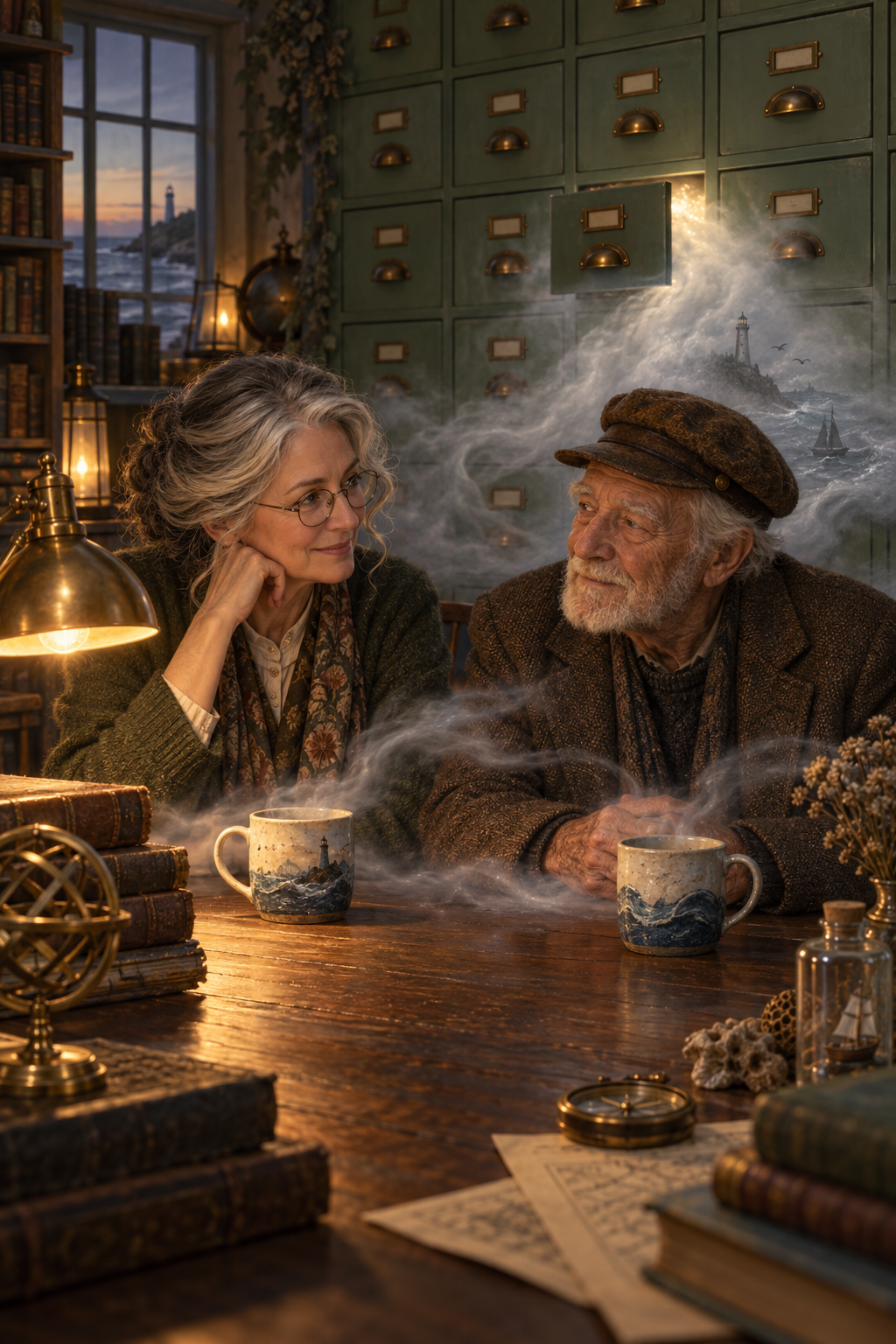
The pen had been dry for six years, and Maren Osk kept it filled anyway.
Synopsis
Maren Osk is the last of the Walking Cartographers, retired to a cottage at Ferry-on-Slate, missing two fingers she paid to guild vellum as a young woman when she drew ground she had never walked. In her world a sworn map binds reality: a road drawn true becomes true underfoot, but only for ground the mapmaker has walked with her own feet — the "ground truth." To draw unwalked ground is conjecture, a lie the vellum cannot hold, so it collects the falsehood out of the cartographer's body instead. When a soaked, desperate girl named Wren Calloway arrives, Maren refuses her outright: Wren's seventeen-year-old brother Lev lies dying of a crushed, festering leg in the Sarrow valley, sealed off after a quake dropped Harrow's Cut, the only pass, and no honest map can conjure a road over a mountain no living surveyor has walked. But Maren has walked to the Sarrow — forty-one years ago, over the long-vanished Ridderpass, with Jossa, who held the chain and used to say "we're on the map now." Because the binding attaches to the walking and not to the place, Maren can lay that true, dead road across the living Cassock. It will hold. It will not fold. The price is not a lie's toll but a spending: a walked road given away is a walked road you can no longer keep. She draws it anyway, and as the pen moves the memories go with the marks — the cold spring at the seventh mile, the switchback where someone laughed, the green valley, and finally the woman herself, until Maren is left weeping at a table she cannot say why, beside a second chair whose occupant she can no longer name. Across the mountains a girl climbs toward a stand of birch that has never led anywhere and now leads home. Maren has traded the only country where Jossa was still alive to save a stranger's brother — the arithmetic of her trade, paid in full.
Cover Art
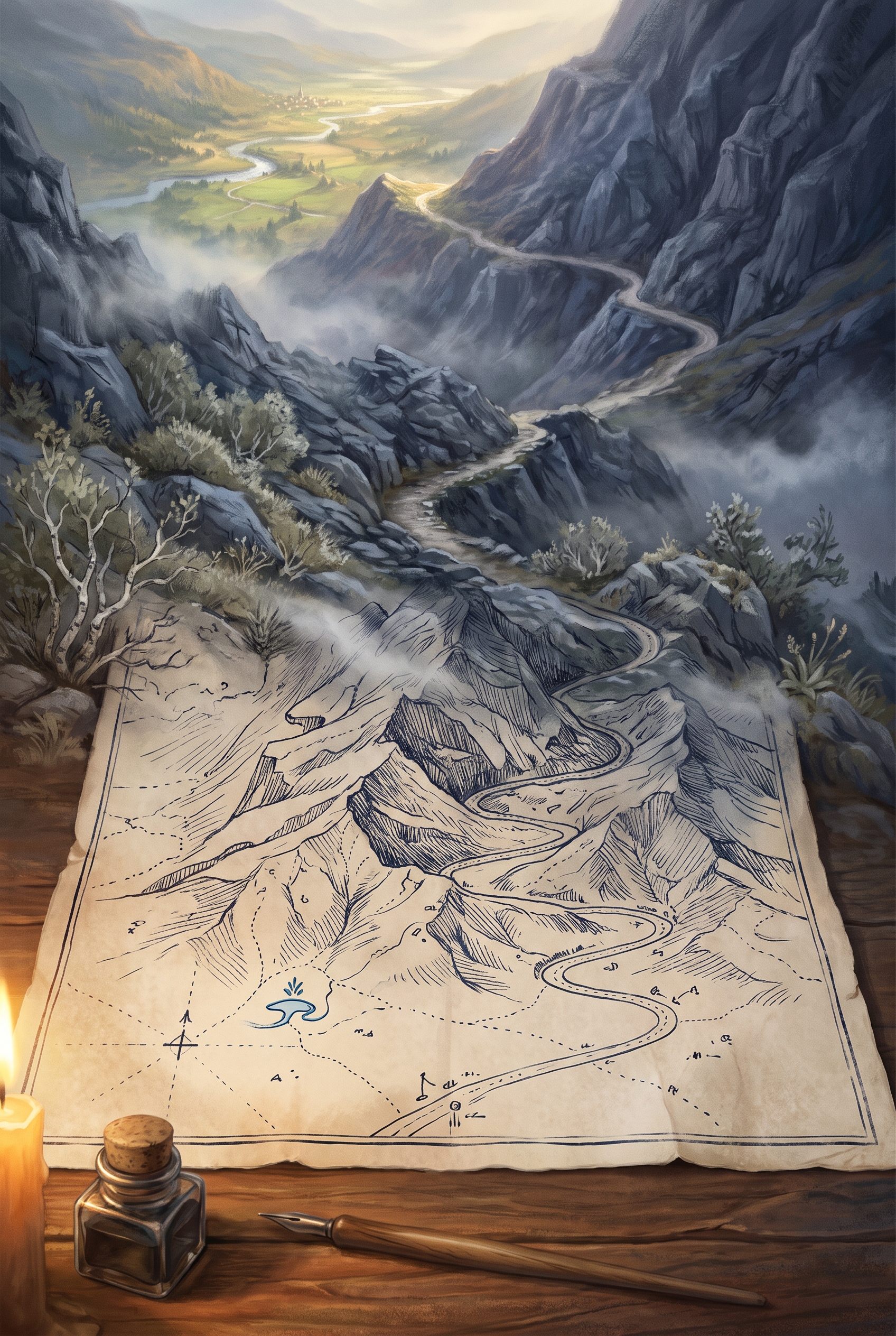
A single continuous vertical image in which a hand-inked cartographer's map — aged vellum, contour hatching, a small blue spring-mark, a dip pen and inkwell in candlelight along the bottom edge — rises seamlessly into a real, misty grey mountain, a pale road winding up its shadowed northern face to a distant, sunlit green valley at the summit. Parchment, ink-blue, cold slate and one warm patch of far green; weathered and bittersweet; no figures, no text.
The Cartographer's Debt
Story
The pen had been dry for six years, and Maren Osk kept it filled anyway.
She did it out of habit more than hope, the way you keep a lamp trimmed in a house no one visits. Every seventh day she wiped the nib, drew off a thumb of gall ink from the jar, and worked a single line across the back of an old ferry receipt to be sure the metal still bit clean. Then she corked the jar and set the pen in its groove and did nothing else with it for a week. The line she drew was never a true line. She was careful about that. A cartographer who has stopped walking must never draw anything that means to be believed.
Her right hand made the test a plain thing to watch. The last two fingers were gone below the knuckle, taken smooth as a river stone, so the pen sat in a grip she'd rebuilt over years around the three that remained. The little finger she'd paid at twenty-six for a bridge she never crossed. The ring finger at thirty-one, for a coastline she'd guessed at in fog. People in Ferry-on-Slate assumed a mill accident or a bad winter. She let them. It was easier than the truth, which was that she had lied on guild vellum twice when she was young and hungry, and the vellum had collected.
The rain had been coming down since noon when the knock arrived. Not the ferryman's knock, which was three and lazy. This was a lot of small fast knocks, the sound of a fist that had been raised a while before it landed.
The girl on the step was maybe nineteen and had walked a long way in wet wool. Water ran off her in a steady rope from one elbow. She had the flat cheekbones and the pale lashes of the upvalley people, and she looked at Maren's hands before she looked at Maren's face, which told Maren the girl already knew whose door this was.
"You're the surveyor," the girl said. "The one who can draw a road that isn't there."
"I'm a woman who used to make maps," Maren said. "Come in before you drown my floor."
Inside, the fire did what it could. The girl would not sit. She stood dripping by the hearth and turned her cap in her hands and got the whole thing out in one breath, the way you say a thing you've rehearsed against a mountain of miles.
Her name was Wren Calloway. Her brother Lev was on the far side of the Cassock, in the Sarrow valley, where their family kept a summer holding for the sheep. Four days ago the ground had shrugged. Harrow's Cut, the only pass into the Sarrow, the one the guild had chained and posted and kept open for thirty years, had come down in a single afternoon. Half a mountain of it. Lev had been up at the high fold when it went, and a stone the size of a cart had caught his leg against the wall of the sheep-cote and pinned it, and the neighbors had dug him out but the leg had gone bad in the way legs do, hot and swollen and streaked, and there was no surgeon in the Sarrow and no way out of the Sarrow and no way in.
"The Cut will take a season to clear," Wren said. "The guild men said so themselves, they said autumn at the soonest, and a new survey over the north shoulder would take them six weeks just to walk it before they could even chain it. Lev doesn't have six weeks. He doesn't have six days. I did the walk here in two and I nearly didn't."
"How did you get out, if the Cut is down?"
"The old drover's track along the river. It floods. It's flooding now. I came through it at night and I won't get back through it, and even if I did I'd bring nothing but my own two hands." She stopped turning the cap. "They say in the Sarrow that once there was a cartographer who could draw a road across bad ground and make it hold. Make it real. That the guild used to do it, before the chains. That you were the last one who could."
Maren looked at the fire for a while.
"Sit down," she said. "You're making me tired."
Wren sat.
"What you're asking has a name," Maren said. "In the trade we call it conjecture. Drawing ground you haven't walked. And the reason the guild stopped doing it, and hangs anyone who tries, isn't law. It's arithmetic." She laid her ruined hand flat on the table between them, palm down, so the two absences showed. "A map made on sworn vellum, in sworn ink, binds the world inside its border. If you draw a road true, the road is true. Passable. Real underfoot. But the vellum only honors ground your own feet have earned. We call that the ground truth. You draw what you've truthed, and it holds, because you're not asking the world to believe a lie, you're only asking it to remember what you already know."
"And if you draw what you haven't walked?"
"Then you've written a falsehood on a page that cannot hold falsehood. So it holds it out of you instead." She turned the hand over, and back. "Sometimes the road even appears. For an hour. A day. Long enough to walk a caravan onto it. Then it folds, because it was never carrying its own weight, you were. It takes the toll out of whatever's nearest and dearest and most spendable. A finger. An eye. A year off the end. A face you meant to keep." She said the last one flatly, and did not explain it, and Wren was young enough not to notice she'd said it at all.
"But you could do it."
"I could kill myself doing it. That's a different sentence."
Wren's mouth went thin. She was not a girl who cried easily, Maren could see, which made the wet in her eyes worse to look at. "He's seventeen," Wren said. "He held the gate for me when I ran. He told the others I'd gone to fetch the cart. He doesn't even know I came to find a witch." She wiped her face with the heel of her hand, angry at it. "I have four silver and a good knife and I'll owe you the rest of my life. I don't know what else to bring to a thing like this. I don't know the price of it."
"No," Maren said. "You don't."
She got up and put the kettle on, because her hands wanted something to do that wasn't the pen. She had refused, and the refusal was correct, and she knew the arithmetic better than any living person because she had paid it in installments. A road across the Cassock was not a finger. The Cassock was a real mountain with real weather and a spine four thousand feet high, and to conjecture a pass over it out of nothing would fold within the hour and take everything she had left, and give the girl a corpse in the doorway for her trouble. That was the honest answer, and she had given it.
But there was another answer, and it had been sitting in the room the whole time, in the way a word sits on your tongue before you find it.
Maren had walked to the Sarrow once. A long time ago, from this same side of the mountains, before Harrow's Cut was ever chained. She'd gone over the Ridderpass.
The Ridderpass did not exist anymore. It had come down the same way the Cut had, in a bad spring forty years back, the whole eastern gallery of it sliding into the gorge, which was why the guild had spent a decade and a fortune blasting the Cut through the softer rock to the south. There was no Ridderpass to walk to. There hadn't been in most of a lifetime.
But Maren had walked it. Every inch. She had truthed it with her own feet, forty-one years ago, in a summer when she was strong and the world was wide and she had not been alone.
The vellum did not care whether the ground still stood. That was the thing the guild had never quite admitted in its own rules, because it frightened them. The binding attached to the walking, not to the place. What you had truly walked, you could lay down anywhere the pen would reach. A true road in the wrong place. Not a conjecture, because there was no lie in it. Every stone of the Ridderpass had held her weight once. It could hold Wren's weight now, across the Cassock, if Maren drew it faithfully enough.
It would hold. That was the difference. It would not fold.
It would still take a toll. Not for lying, but for spending. Drawing a walked road for someone else's feet was like reading a letter aloud until the ink wore off the page: once it was given away, it was gone from you. The guild had a dry phrase for that too. Maren stood at the kettle and could not, for a moment, remember the phrase, and then she could, and wished she hadn't. You cannot keep the road you give away.
She had walked the Ridderpass with Jossa.
Jossa had held the chain. That was the shape of them for eleven years: Maren drew and Jossa measured, sixty-six feet of iron links paid out and drawn in across every mile of the eastern ranges, and at the end of a day Jossa would drop the chain in a bright heap and say the same three words, we're on the map now, as if the map were the real country and the mountains only its rough draft. The Ridderpass was the best walking they ever did. Maren could still feel the whole of it. The cold spring at the seventh mile that ran straight out of the rock like a promise. The switchback where Jossa had laughed so hard at something, some stupid thing, that she'd had to sit down on a stone with the chain across her knees. The last rise where the Sarrow opened out below them, green as a held breath, and Jossa had said, oh, and nothing else, because there was nothing else.
If Maren drew that road across the Cassock, she would be spending that walk. All of it. The spring and the switchback and the green valley and the woman who had said oh.
She would give away the only country she had left where Jossa was still alive.
The kettle came to a shriek. Maren took it off.
"How bad is the leg," she said, not turning around. "The truth of it. Not the truth you told your brother."
Wren was quiet a moment. "The streaks are past the knee," she said. "It smells."
Maren nodded to the wall. She had known a leg like that in the guild years, a chainman gone under a rockfall, and she knew the arithmetic of it the way she knew the other kind. Days. Fewer than Wren wanted to believe. More than nothing.
She set the pen and the ink jar and the flat guild case on the table, and she watched the girl's face change, and she thought: I am a foolish old woman, and this is not my brother, and I have paid enough. Every part of that was true. She unrolled the vellum anyway.
Guild skin was pale and close-grained and took ink like still water takes a stone, without a ripple, the line simply there where it had not been. She weighted the corners with the ferry-stones she used for nothing else now. She built the ink the way she'd built it ten thousand times, iron and oak-gall and gum and the single dark drop from the ball of her own thumb, worked with the flat of the blade until it went from brown to the true blue-black that meant it would bind. Her three fingers found the grip. The nib touched the skin.
She drew the Cassock first, because you draw the true thing before you draw the road across it. The mountain came up under her hand as it stood, hunched and grey, its shoulders where they were, Harrow's Cut a broken notch to the south with a scatter of fresh scree she inked in from Wren's account and marked, honestly, as unwalked and closed. Then she found the place on the northern face where the Ridderpass had begun, forty-one years and one mountain away, and she set the pen down at the foot of it, and she began to walk.
That was the only word for what it was. Her hand moved and her feet remembered. First mile, the birch scrub and the long traverse. Second mile, the ford. She drew the ford and felt it leave her, the exact cold shock of that water on a July morning lifting off her like steam, there and then gone. Some part of her had not believed, until now, that it truly would. Third mile, the shale. Fourth. The pen laid the road down clean and sure across a mountain it had never seen, and the road held, she could feel it holding, the vellum drinking the line without a tremor, because none of it was a lie.
Seventh mile. She reached for the spring, the one that ran straight out of the rock, and drew the small blue mark that meant sweet water, and the taste of it went. She had not tasted that spring in forty years and now she never would again, and she made the mark anyway, and her hand did not shake because a cartographer's hand does not shake, that is the first thing they take from you and the last thing you give back.
The switchback came under the nib. She drew the double bend of it and waited for the thing she was bracing against, the stupid wonderful thing, someone laughing, someone sitting down on a stone with sixty-six feet of iron across her knees, and she reached for it the way your tongue reaches for a missing tooth, and the socket was already smooth. There was a switchback. It was a good switchback, well-graded, it would carry a laden pony. Someone had been happy here once. She could no longer have said who.
She kept drawing. There was less of her behind the pen now and she did not entirely know why, only that the work had the weight of grief in it and she could not find the grave. The last rise. The Sarrow opening out. She drew the valley green and true and safe, every field of it earned by feet she could still, barely, remember owning, and at the top of the last rise she left the smallest gap, a single unlinked pace, the way you do, so that the last step onto the map is taken by the one who needs it and not by the one who made it. Then she lifted the pen.
The road was there. On the vellum and, she knew without going to the door, on the mountain, laid down over the Cassock's northern face from the valley floor to the Sarrow like a seam sewn into cloth that had never had a seam. It would hold as long as the ink held. Weeks. Long enough.
"It's done," she said. Her voice came out strange. "Go out the north gate and up the drover's stones to where the birch starts. You'll find the way at the birch. Walk it like you mean it and don't stop to wonder at it, wondering makes it worse. Bring your brother back over it before the frost, because after the frost I can't promise the ink."
Wren was already at the door, and then she was not, she had come back and taken Maren's ruined hand in both of hers, the three-fingered hand, and she was saying things, thank you and I'll come back and I'll bring the four silver and the rest of my life, all the things people say when they've been handed a thing they cannot pay for. Maren let her say them. Then the girl was gone into the rain, running, and the door banged, and the cottage was very quiet with the fire ticking and the kettle cooling and the map lying finished on the table with its corners under the stones.
Maren sat down. She was crying, she found, in the plain leaking way of the old, without any storm behind it, and she could not for the life of her say what the tears were about. Something had been in the room a moment ago and now it wasn't. She had the strong and stupid sense of having set something down in a safe place and forgotten where, the way you do with a key, with a name, with the reason you walked into a room.
There was a second chair at her table. There had always been a second chair. She looked at it and felt the shape of a person in it the way you feel the shape of a word you've lost, all its edges and none of its middle. A woman. Iron in a bright heap. Three words she used to say. Maren reached after it and reached after it and there was only the smooth socket where the reaching stopped.
On the far side of the mountains, she knew, a girl was climbing toward a stand of birch that had grown on the drover's stones for forty years without ever once leading anywhere, and would lead somewhere now. A boy who held a gate would be carried home over a road that a spring, and a ford, and someone's laughter had paid for. That was the arithmetic. It had always been the arithmetic. You cannot keep the road you give away.
Maren wiped her face with the heel of her hand, the way the girl had, and did not know she was borrowing the gesture.
After a while she got up and filled the pen, because it was the habit of a lifetime and the metal must not be left to dry. She drew off a thumb of ink. She pulled the ferry receipt toward her to make her weekly line, the line that was never a true line, and she found her three fingers set themselves without being told to a double bend, a switchback, a well-graded thing that would carry a laden pony. She stopped. She looked at it. It was a good road. She could not think where it went, or who had walked it, only that someone had, and had been glad, and that the gladness was somewhere now that she would never again be able to reach, spent on a stranger's brother, which was, she supposed, drying the nib carefully and setting the pen back in its groove, the only honest place for a thing like that to go.
Outside, the rain was easing. She left the map on the table with its corners under the stones, and did not look at the empty chair again, because she no longer remembered that she was not looking.
More from Short Stories