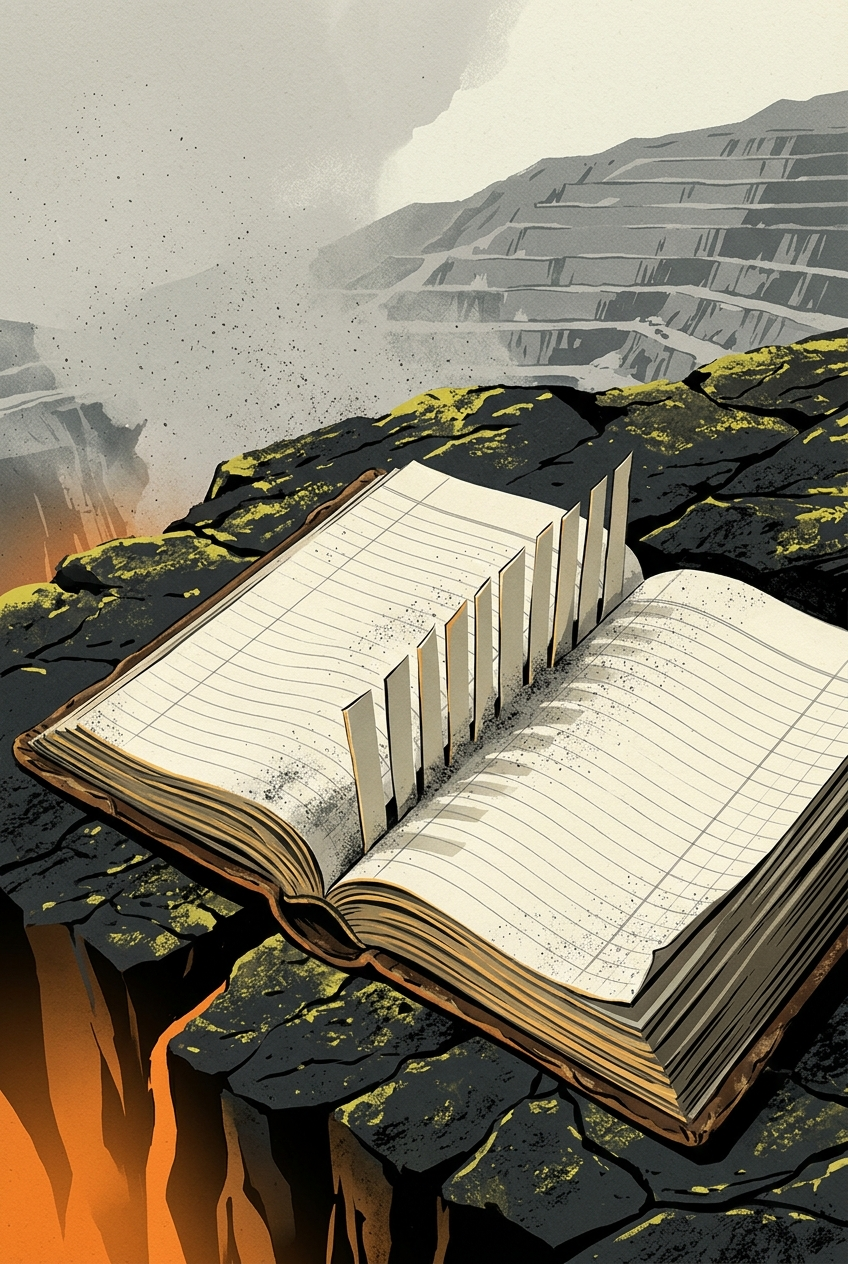
Saltwalker
The rope was the first thing Ise checked and the last thing she trusted.
Synopsis — "Saltwalker"
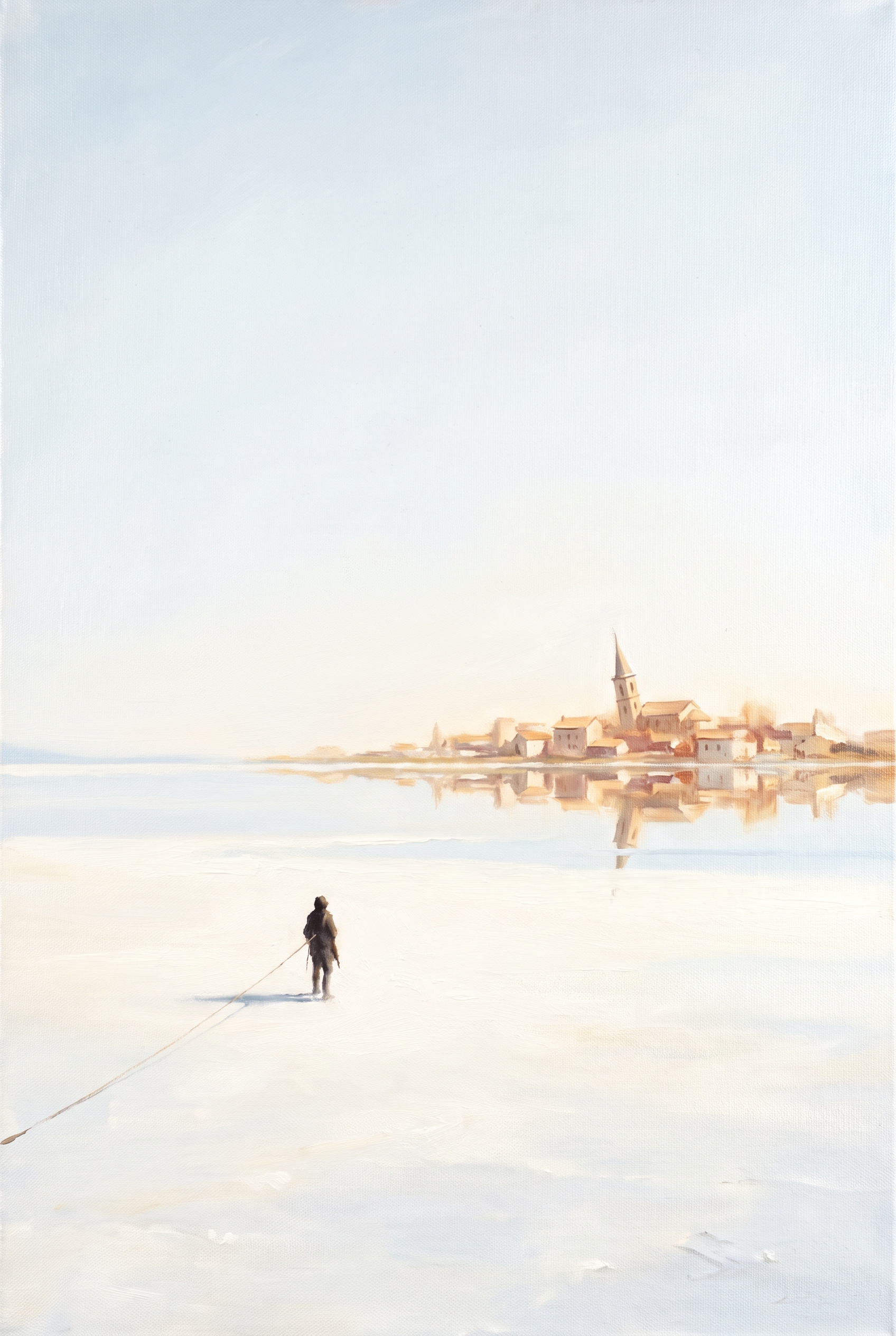
In the salt-bleached town of Sarn, a vast dried sea called the White kills anyone who wanders onto its rotten crust — except for three days a year, when the heat lays exactly right and the flat doubles, throwing up a shimmering mirror-town on the horizon where the grieving can glimpse their dead. Ise is a saltwalker: for eleven years she has roped strangers to the edge of that mirage so they can look but never cross, and in all that time the Bright has never once shown her the sister she believes she sent to die. Guiding an old widower out to see his wife, Ise spots Wren standing at the far edge — not a frozen vision but a living woman, eight years older, waiting. She breaks the one rule of her trade and walks in, and learns what the whole town has agreed never to know: the salt takes no one. The Bright is real, the "dead" are the living who chose to vanish, and Wren does not want to be rescued. Forced to choose between the absolution of bringing her sister home and the freedom of leaving her gone, Ise gives up her own forgiveness, walks back across the crust, and tells the oldest lie in Sarn — that the salt took her — making it true, at last, on purpose.
Saltwalker
Story
The rope was the first thing Ise checked and the last thing she trusted.
She looped it now around Aldous Reeve's chest, under the arms, the way she'd looped it around a hundred strangers, and felt him stiffen at how hard she drew it. They all stiffened. People came to the White wanting it to be gentle, and the first thing a saltwalker taught them was that it was not.
"Too tight," Aldous said.
"It's meant to be." She tied the bowline off and pulled twice, watching his face and not the knot. "If the crust opens under you, this is what brings you up. Not your arms. Not mine. This."
He was seventy at least, with a farmer's neck and hands gone soft only recently, the way hands did when a wife died and there was no one left to cook for. He had come to her door three evenings running before she agreed. That was how she chose them. The ones talked out of it by their own good sense she never saw again, and that was correct. The ones who came back would go onto the salt with or without her, and those she would rather have on a rope.
"You've done this," he said. It wasn't quite a question.
"Eleven years."
"And you've never gone in."
"No." She shouldered the water skin and the short pole and stepped past him onto the crust. It took her weight with the small dry crunch she had loved since she was a girl, the sound of the whole flat holding still under her boot. "That's the other thing I'll teach you, Mr. Reeve, and it matters more than the rope. We walk to the edge. We look. We do not step across. Whatever you see out there, whoever you see, you keep your feet on this side of the shimmer. Say it back to me."
"We don't step across."
"Whoever you see."
He was quiet a moment. Behind them Sarn sat low and salt-bleached at the shore of the flat, roofs the color of old bone, the last market smoke going straight up in the windless heat. Ahead there was nothing at all, only the White running out flat and blinding to where it stopped being ground and became sky.
"Whoever I see," he said.
They walked.
The White was thirty miles of dried salt sea, and for most of the year it was only that, a dead pan with brine sulking a hand's width under the crust, waiting for a wheel or a boot to break through. Children were beaten for going out on it. Men who tried to cross it to save two days' travel were found curled in a soft spot with their mouths full of white. The salt took them. That was the phrase, worn so smooth no one in Sarn heard the shape of it anymore. The salt took my father. The salt took the Hallet boy. The salt took your sister, Ise, God keep her, you mustn't blame yourself.
But for three days a year, when the dry was at its deepest and the heat lay on the flat exactly right, the White did something else.
It doubled.
You would be walking, as they were walking now, and the far edge of the world would thicken. A smudge would gather along the line where salt met sky and sort itself into a town. Roofs the color of old bone. A market square. The same crooked spire the masons of Sarn had never got straight. It hung above its own reflection, trembling, close enough on the third day to see the doors, and it was called the Bright. The whole trade of the saltwalkers was built on one fact: that people would give anything to walk to the edge of it and look.
Because you saw them there. The taken.
Not always. Not for everyone. But often enough that the trade held. A woman would see her drowned husband in the square with his hat in his hands. A man would see the daughter the fever got, six years old and six forever, chasing something only she could see. They stood at the shimmer while their dead stood in the doubled town, and the two of them looked at each other across a distance that was not any number of miles.
"There," Aldous breathed.
The Bright had come up while they walked, arriving the way sleep arrives, so you could not name the moment it began. The spire stood crooked against the white sky. Ise could see the doubled market, the doubled shore, and small in the square the moving specks that were not birds.
"Keep walking," she said. "Slow. It's still far. It'll come closer than you think it can."
He was crying already, silently, the way old men cry, and she let him. Her business was his feet and the rope and the light. A saltwalker was not a priest or a guide to the dead but a reader of the hour: the Bright held only while the heat held, and when the light turned, the flat would remember it was only a flat, the soft spots would sweat up through the crust, and you did not want to be far out when that happened.
"Manda," Aldous said, to no one, to the town.
Ise looked where he looked and saw an old woman in the square, small and stooped, shading her eyes toward the shore, and the old thing turned over in her chest, the thing that never stayed down: for eleven years she had walked people out to see their dead, and never once seen her own.
She had looked. God, she had looked. Every season, while her clients wept at their mothers and their sons, Ise had scanned the doubled square for a girl of nineteen with a crooked front tooth and their father's black hair, and it had never once given Wren back. The Bright showed you your taken. It had never shown her Wren. So Wren was not taken; Wren was only dead, plain dead, the ordinary way, out on the crust in the dark, and even the salt's one mercy was not for her, because Ise had earned no mercy.
The night Wren went out, she had come to Ise's room and stood in the door and asked her sister to walk her onto the White.
"There's nothing out there for you," Ise had told her. Eight years ago. She had been half asleep and wholly a coward. "The Bright doesn't take the living, Wren, it only shows the dead, and it isn't even the dry season, there's nothing out there but brine and the dark, go back to bed."
"Walk me out," Wren had said. "Please. Tonight."
"Marry him," Ise had said, because that was the real conversation and they both knew it, "or don't marry him, but stop dreaming about the salt like it's a door. It's a floor and it's rotten. Go to bed."
Wren had gone to bed. In the grey before dawn she went out onto the White alone, in the wet season, no rope and no walker, and did not come back. Coll Farrow, who held the salt lease and the Marran debt and the marriage that would have cleared it, stood at the edge with the search party and said the words. The salt took her. Everyone turned to Ise with soft eyes and told her she mustn't blame herself, and she understood, standing there, that she would do nothing else for the rest of her life.
"She sees me," Aldous whispered. "Ise. She sees me."
"I know." She put her hand flat between his shoulders, steadying, the way you'd steady a fence post you'd just set. "Stay on your feet. You can lift your hand to her. Slow."
He lifted his hand. Across the shimmer, small and stooped, the old woman lifted hers.
And past her, at the very edge of the Bright where the doubled shore met the doubled White, a girl was standing.
Ise's hand stopped on the old man's back.
The girl was not stooped and not old. She stood the way Wren had always stood, weight on one hip, chin a little lifted, as if the world were a thing she was deciding whether to be impressed by. She had their father's black hair. She was not nineteen. That was the first wrong thing, the thing that made Ise's breath go strange, because the girl at the edge of the Bright was a woman of twenty-seven, which was exactly, to the year, to the season, what Wren would have been, and the Bright did not age its dead, it kept them at the age the salt had them, everyone knew that, everyone knew that, and so a woman standing at the edge of the doubled town with Wren's hip and Wren's hair and eight more years on her face than the salt should have allowed could not be one of the taken at all.
She was just Wren.
Older. Alive. Looking straight across the shimmer at her sister, not surprised, the way you are not surprised by a thing you have been waiting a long time to arrive.
"Ise?" Aldous had felt her go rigid. "Are you unwell?"
The light was still high. She made herself check it, because she was a saltwalker and the light was her whole religion. Still high; they had a little time. She looked at the old man weeping at his wife, and at her sister standing where no living woman could stand, and the trade she had given eleven years to came apart in her hands like a knot pulled by the right end.
The rule was you did not cross, because your dead were not there. That was what Sarn taught its children: the Bright was a fever the flat ran once a year, only a picture, and to walk into it was to go thirty miles into brine with your arms out toward a reflection. The few who had tried, the ones mad with grief, had been pulled back drowning or not pulled back at all. Everyone knew it. No one said it. The town had agreed, without once agreeing aloud, to believe the salt killed, because the other thing was worse.
The other thing was that the Bright was real, and the disappeared were in it, and they had walked there on purpose.
"Mr. Reeve." Her voice came out level, and she was proud of that later. "I'm going to seat you. Down, that's it, sit on the crust, it'll hold you, I've weighed it. Keep looking at your Manda. Don't get up. Don't follow me. Whatever you see, you keep your seat, and when the light turns you get up and walk the rope home. It's tied to my belt. If it goes slack, gather it as you come. Straight back toward the smoke. Say it."
"Straight back toward the smoke." He gripped her wrist. His eyes were streaming and clear. "You said we don't cross."
"I know what I said."
She untied the rope from her own body, made it fast around the pole, and drove the pole through the crust into the softer salt until it stood on its own, coiling the slack at the old man's feet. Then she stood with no rope on her for the first time in eleven years of the White, and the flat felt enormous and personal, the way the sea must feel to a woman who has finally decided to swim out.
"You'll die," Aldous said quietly.
"Maybe." She was already looking at Wren, who had not moved, who waited with the terrible patience of the far shore. "But she's aged, Mr. Reeve. Look at her. The dead don't age. If I'm wrong, the salt has me, and you tell my town the salt took me, and that will be the truth and everyone will believe it and no one will blame you." She almost smiled. "And if I'm right, there's a town out there full of people we've all been grieving, and not one of them is dead."
She stepped across the shimmer.
There was a moment of cold, brine over her boots, and she thought, with the flat certainty of the drowning, that she had been the fool after all, that the Bright was only a picture and she had walked her arms out toward a reflection like every mad one before her. The crust gave. The white closed over her knees. Sarn's smoke swung away and the doubled town swung close and thin, and she could not tell which shore was true, and heat and salt and light ran together into one white roar.
And then it was not cold. The ground was ground. A hand had her by the wrist, hauling, and she came up out of the shimmer onto a crust that crunched dry under her palms, kneeling in a market square she had watched for eleven dry seasons and never once entered. The crooked spire stood over her, exactly as crooked. Her sister crouched in front of her with eight new years on her face, holding both her wrists, saying her name.
"You stupid woman," Wren was saying, laughing and furious both, the way she had since she was small, holding two whole weathers in one face. "You stupid, stupid woman, after all your rules, after all your rope. You crossed."
Ise could not speak. She put her hand to her sister's cheek to see if it would go through. It did not; it was warm and dry, and there was a scar at the jaw that had not been there eight years ago, a small white line, a life's worth of story she had not been in the room for.
"You're old," Ise said. It was all she had.
"So are you." Wren's laugh broke in the middle. "God, Ise. So are you. Get up. The light's turning, you have to feel it, you always could feel it before any of us. Get up and I'll walk you to the edge."
Around them the square was not empty. Ise saw the Hallet boy carrying water, the Hallet boy who had gone under the crust at twelve and was twenty now if he was a day. She saw a woman she had buried in memory ten years back, grey at the temples where she had no business being grey. They were all older than the salt should have left them, and her clients had stood at the shimmer season after season and never once counted, because grief does not count birthdays. It keeps a face and calls it forever. Across the square an old man stood in a hat, and Ise understood with a lurch that on the true shore Aldous Reeve was watching his Manda in a Bright doorway, that Manda was not dead either, that she had walked out here like all of them, and that the old man would go home tonight and grieve a woman who was, this whole time, alive.
"They're not dead," Ise said.
"No."
"Any of them."
"No." Wren pulled her up. She was strong; she had always been stronger than she looked, the thing about her that Coll Farrow had wanted and the thing that had saved her. "Some of them wanted to be. That's a different thing. Ise, the light."
Ise felt it turn, the way it always had, a small dropping-off in the heat, the flat somewhere beginning to sweat. On the true shore she had perhaps a quarter hour before the soft spots opened. Here she did not know what she had, and that frightened her more than the crossing had.
"Come back with me," she said. The words were out before she had decided to spend them. "Wren. Come home. Come back across with me now, there's time, I'll rope us both and walk us straight to the smoke. Come home and let me tell them. Let me stand in the square and tell Sarn the salt never took anybody, that you're all out here, that you're alive, that I didn't, that I never." Her voice did the thing she had spent eight years making sure it never did in front of anyone. "That I didn't send you to die."
Wren's face changed. The two weathers went out of it and left something older and more careful, a face Ise knew from the night in the doorway, and she understood that she had asked the wrong thing.
"You didn't send me to die," Wren said. "Ise. Look at me. You sent me here. You told me the salt was a floor and not a door, and it was the meanest thing you ever said to me, and it was the thing that made me go, because I was so angry at you I stopped being afraid. I walked out in the wet season with no rope because you told me there was nothing out here, and there was everything out here. You didn't fail me. You were the last shove. I had eight years to hate you for it and I stopped, a long time ago, because look." She spread her hand at the square, the water, the doorways, the whole impossible living town. "Look what you shoved me into."
"Then come home."
"To what." It was not a question and Wren did not soften it into one. "To Coll Farrow, who still holds the paper. To a town that would need me to be a miracle or a corpse and nothing in between. Ise, if I cross back with you, I am the girl the salt gave up, and there is no life in Sarn for the girl the salt gave up. There's only the story. You'd have your absolution and I'd have their eyes for the rest of my life." She took Ise's face in both hands, the way you hold a child you are about to disappoint on purpose. "I'm not a thing you can bring home to be forgiven with. I'm your sister and I'm alive and I'm asking you to leave me that way."
The light dropped again. Further, this time. Ise felt the true shore begin to remember itself, thirty miles of it, and the pull of the rope tied to a pole where an old man sat weeping at a woman who was not dead.
"What do I tell them," Ise said.
And here it was, the thing the whole trade was built to hold shut. Wren said it plainly, because she was on the other side of it and could afford to.
"Tell them the salt took me."
Ise stood in the doubled square with her sister's hands on her face and understood, finally, what the rope was for. Not the crust. The crust was the story the trade told. The rope kept people at the edge so that none of them would ever cross and learn that the missing were not missing, that they were here, that a town could keep its dead only for as long as it never came looking for its living.
She had spent eleven years keeping other people from doing what she had just done.
"You'll be all right," Ise said. It was not a question either. She was learning her sister's grammar again.
"I have been for years." Wren's thumb moved once against her cheek. "The scar's a long story and it ends well. Come at the dry, if you want. Walk to the edge like the others. I'll stand where you can see me. You'll know it's me because I'll be older every time, and none of your clients will ever notice, because they'll all be looking at their own." She stepped back. The light was going hard now, the far shore calling up its brine. "Go, Ise. Feel the light and go. That's the one thing you were never wrong about. You always knew the hour."
Ise went.
The crossing back was worse because she went with her eyes open, and for the length of a held breath she saw the true shape of the White: neither the killing floor of Sarn's belief nor the doubled town of its grief, only a vast flat mirror between the two, indifferent, holding both the way water holds the sky and the drowned man at once. Then the brine was at her waist, the smoke swung close, and old soft hands hauled her up onto the crust of the true world beside Aldous Reeve, who had not moved, who had gathered the rope into his lap and held the pole, who looked at her as if she had come back from the moon.
"The light's turned," he said. "Ise. We have to walk."
"I know." She got the rope onto herself with hands that did not quite work. Behind them the Bright was thinning already, the spire going soft, the square dissolving to a smear of white on white, and somewhere in it a woman of twenty-seven stood with her chin lifted, watching her sister get up off the floor of the world. Ise did not look back for long. Looking back was for the clients. Her business was the hour and the rope and the smoke.
She walked Aldous Reeve home across the crust, testing every soft place with the pole, and he was quiet most of the way, until the roofs of Sarn came up bone-colored and near.
"She was alive," he said. "Wasn't she. Your girl. I saw you take her face."
Ise walked three steps before she answered, and when she did she was surprised how easily it came, how it fit her mouth like a thing she had been made to say: the oldest sentence in the town, worn smooth as a river stone, true now in a way it had never been, because she had gone and made it true with her own two feet.
"The salt took her," she said. "Years ago. I only ever come out to look."
Aldous Reeve nodded slowly. He was an old man who had walked to the edge of the world to see his wife shell beans in a doorway, and he would go home and lay a place for no one and call it grief, and Ise let him keep it, the way Wren had let her keep hers.
"Aye," he said. "Mine too."
She looked at him then, and knew that he knew, and that neither of them would ever say another word about it.
At her door he paid her, and asked when the dry would come again, and she told him a year, near enough, and did not tell him not to come. Some of them came back. Those were the ones she'd rather have on a rope.
She coiled the rope that night by the fire and checked it end to end, the frayed places, the good places, the splice her father had taught her that she had never had cause to trust until today. Outside the flat lay white under the moon, thirty miles of it, holding the sky. Somewhere in the middle, if you believed the thing that no one in Sarn would say, a woman with a scar at her jaw was putting out a lamp under a crooked spire, older by a year than the salt had any right to make her.
When the dry came Ise would walk out to the edge with some weeping stranger on her rope, and she would find, in the doubled square, the one face her clients never saw. It would be a year older. She would lift her hand, slow, and keep her feet on this side of the world.
She banked the fire and slept, and did not dream of the crust opening, for the first time in eight years.
More from Short Stories