The Widowhood System
The perch that mattered was empty, and Vera stood in the doorway of the loft with the corn scoop in her hand and did the sum three times before she trusted it.
Synopsis — "The Widowhood System"
Eighteen months after burying Ron, Vera Ackroyd is still keeping his racing pigeons in a dying Yorkshire pit-village club, and one morning before the big National from France she finds his best hen, Duchess, missing from her box. What Vera won't tell the club — or her grandson, who wants her in a bungalow with a wet room and no loft — is that she let the bird out herself, at four in the morning, meaning it as a mercy she couldn't give the rest. But a homing pigeon has no use for freedom; it flies to the nearest home it can find, which lands Duchess two miles west on the immaculate loft of Malcolm Sowerby, Ron's lifelong rival. When Vera goes to reclaim her hen, the man she's refused to say good morning to since 1994 quietly reveals he nursed the exhausted bird back to health and had planned to cover for Vera's grief without ever letting on — because with the club down to nine funerals in a queue, he can't stand to lose the best line left in it, or the widow of the only flyer he ever respected. Vera enters Duchess in the race after all, and on Saturday afternoon the hen drops out of an empty sky onto the loft roof, home from France, having crossed a sea to refuse the freedom Vera tried to give her. A dry, tender story about grief, staying, and the difference between letting something go and giving it somewhere to come back to.
The Widowhood System
Story
The perch that mattered was empty, and Vera stood in the doorway of the loft with the corn scoop in her hand and did the sum three times before she trusted it.
Twenty-two birds. There should have been twenty-three.
She knew every one of them the way you know the backs of your own hands, which is to say she never actually looked at her hands and could still have drawn them in the dark. The two red chequer cocks on the top box, tucked up like a pair of magistrates. The blue hen with the bad foot who had never won a card in her life and never would. The young birds crowding the drinker, all elbows, believing the world was corn. She went along the perches with her eyes and the sum came out the same each time.
Duchess was gone.
Not dead on the floor with her neck at the wrong angle, which is how a sparrowhawk leaves them. Not a heap of feathers by the pop-hole, which is a cat. Just a gap on the second box where a slate hen with a bar across each wing should have been sitting, turning her head to the light the way she did, as if she thought the light had come specially.
Vera set the scoop down on the shelf. The birds shifted and murmured. Outside, over the slate roofs of the terrace and the long back gardens with their whippet runs and their rhubarb, the sky was going the colour of dishwater, and it was Thursday, and on Saturday morning at some ungodly hour a man in Bergerac would open a lorry full of Yorkshire pigeons and let them all go home at once.
Marking night was tomorrow. You brought your birds down to the club in a basket, and Kenneth Ryecroft rubber-ringed the leg of each one and wrote the number in the book, and off they went to France in the transporter to be liberated at dawn. Ron had never missed a National in forty-one years. Vera had entered the loft in her own name for eighteen months now, which was as long as Ron had been in the ground, and she had not missed one either, because she could not, for the life of her, work out how a person would go about stopping.
She looked at the empty box for a while longer.
Then she latched the loft, and went in, and put the kettle on, and did not ring anybody.
The trouble started, as trouble in the Fed always did, at the club.
She had not meant to say anything. But Kenneth had the marking book open on the trestle table under the dartboard, and he ran his pen down her entry and said, "No Duchess, Vera? I'd have thought she'd be your first pick for a hard one."
"She's off form," said Vera.
It came out flat and easy, and she was surprised at herself, at how little it cost. The men round the table were basketing their own birds and half-listening. There were nine of them and there had been thirty when Ron started, and the youngest was Colin Hesketh's lad who was fifty-three.
"Off form," said Malcolm Sowerby, from the corner where he always sat, with his flask of his own tea because he didn't trust the urn. "In August. On a west wind."
She did not look at him. That was the discipline of it. You did not look at Mal Sowerby, the way you did not look directly at a wasp that had got into the car.
"That's what I said."
"She were bang on last week. I saw her come off Nantwich. Dropped like she'd been thrown." He screwed the cup back onto his flask. "Off form."
"Malcolm," said Kenneth, gently, in the voice a secretary uses.
"I'm only saying." Mal stood, and gathered his empty basket, and his coat, which was the same coat he had been wearing since the Callaghan government. At the door he paused, and looked back at her, not unkindly, which was worse. "You want to mind that loft of yours, Vera. Birds don't come off form. Birds get let out."
And he went, and the door banged, and the dartboard shivered on its nail, and Kenneth said, "Take no notice, love. He's been chunnering about that hen for a fortnight. He's got it into his head your Ron's Janssen line is better than his and it's eating him alive." He clicked his pen. "You want to withdraw her from the book proper, then? Officially?"
"Aye," said Vera. "Officially."
She walked home the long way, past the allotments, where the light was failing and the runner beans stood on their canes like something waiting to be told what to do. She thought about the word Mal had used. Let out. As if it were the most natural verb in the world.
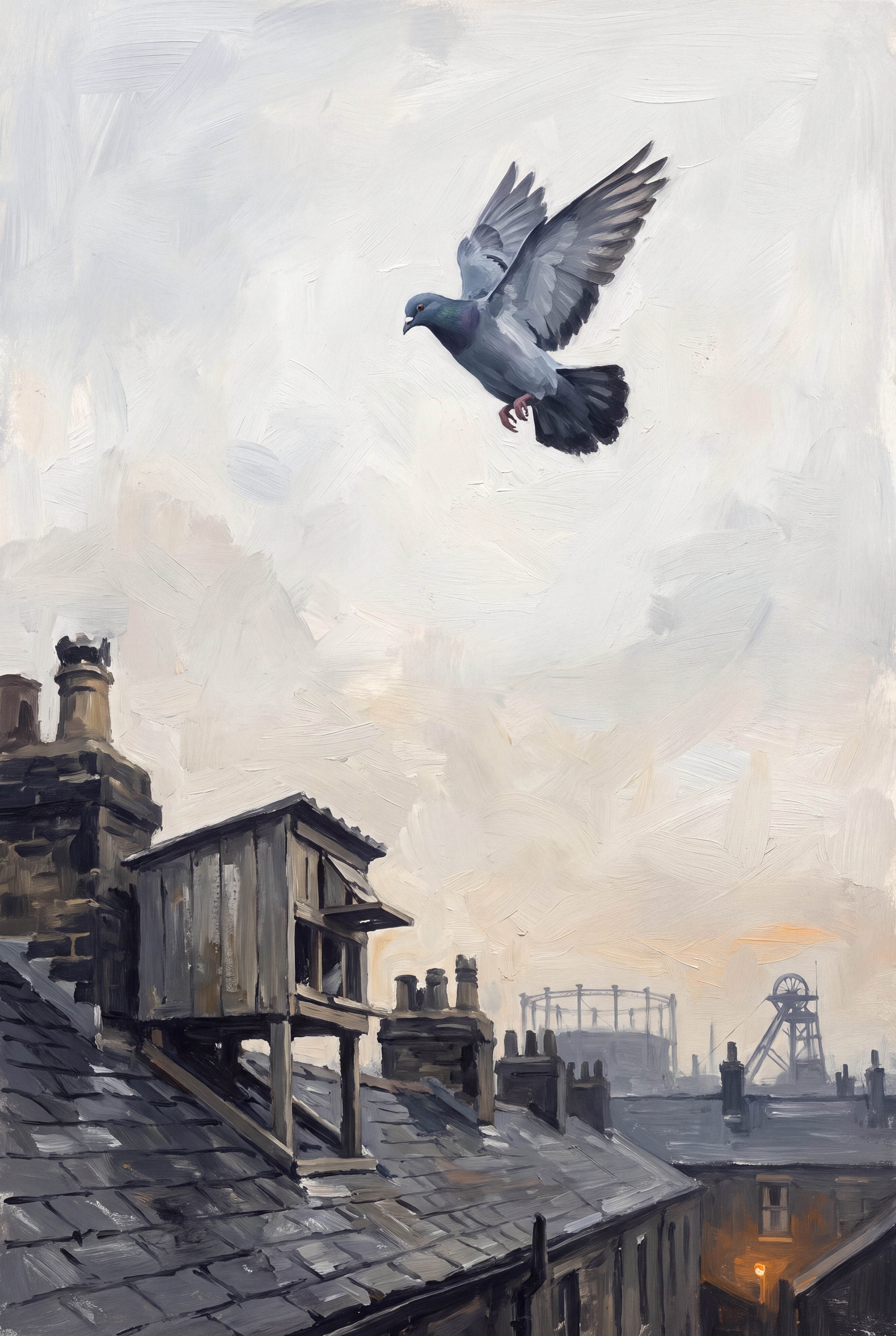
The thing about a homing pigeon that people who are not fanciers never understand, and that Vera had spent a marriage failing to explain at christenings and funerals, is that it is not really a pet. You do not keep it. It keeps you. You can open the loft on a summer evening and stand in the garden with your tea while sixty of them go up all at once with a noise like a bedsheet snapped out over a bed, and they will wheel and climb until they are just a pepper of dots over the gasworks, and every particle of your good sense will tell you that is the last you'll see of them, they've gone, why would they not, the whole sky is theirs. And then they come back. They always come back. They fall out of the emptiness and pour down onto the loft roof and squabble at the pop-hole to be first in to the corn, and you have done nothing to deserve it, and they have chosen, again, for reasons no one has ever got to the bottom of, the small dark box where you keep them and the sound of your voice.
Ron used to race the cocks on the widowhood.
It was a system. You paired a cock to a hen in the spring and let them settle and get broody and love the nest bowl and each other, and then on the Thursday you took the hen away. You shut her in a separate section where he could not get to her, and you basketed him off to France, and the whole two hundred miles home he flew like something scalded because the one thing in the world he wanted was on the other side of a partition he could not see over. That was the trick of it. That was the engine. You did not fly the bird on hunger or fear. You flew it on the hen it had been parted from. The men said widowhood the way they said chequer or velocity, a word worn smooth by use, and none of them, so far as Vera knew, had ever once heard it.
She had heard it. She heard it now, standing in her kitchen at half past nine with the immersion heater ticking, eighteen months a widow, the last of Ron's Janssen hens two miles away on a roof that was not hers, and the loft in the yard with its empty box, and the small brass fact of what she had done at four o'clock on Wednesday morning sitting in her chest like a swallowed button.
She had gone out in her nightdress and her wellingtons. It had not been a decision so much as a sleepwalk with the eyes open. She had unlatched the loft and gone in among the sleeping birds, who muttered and did not wake, and she had lifted Duchess off the box with both hands, the way Ron lifted them, the way he had taught her, thumbs over the back and the wings folded soft under her fingers and the heart going like a clock under her thumbs. She had carried her out into the yard. The stars had been doing whatever stars do at four in the morning over a Yorkshire pit village, which is to say very little.
And she had opened her hands.
She could not have said why. Sam had been at her for months about the bungalow in Garforth, the one with the wet room and the little paved bit you couldn't call a garden. You can't be doing with all that on your own, Nan. The birds. The loft. Dad would want you settled. And she had sat with the brochure on the arm of the chair and looked at the wet room and understood, in a slow cold way, that she was going to have to break up the loft. That there was no version of the future with a wet room in it that also had sixty pigeons and a marking night and Mal Sowerby's flask. That you did not take pigeons to a bungalow. That you sold them, or you wrung their necks, or you gave them to men who would race them in their own names, and that Ron had bred these birds out of birds his father had bred, and there was no more of that coming, not ever, because the fifty had become thirty had become nine, and the nine were dying, and after the nine there was nobody at all.
And she had thought, in the loft, at four in the morning: I cannot do it to all of them. But I can do it to one. I can give one of them the thing the whole system is built on pretending to withhold. I can let one of them go.
So she had let Duchess go. She had stood with her empty hands up over her head like a woman surrendering, and the hen had gone up into the dark with a clatter and was gone, and Vera had felt something she had no word for, which was the closest she had come to grief in eighteen months of not letting herself near it.
And then she had gone in and made tea and waited to feel better.
She had not, at any point in the whole daft business, remembered the one thing she knew better than her own hands.
You cannot give a homing bird its freedom. It does not want it. It has no use for it. Open your hands over your head at four in the morning and it will not fly away to be free, because there is no such place; it will fly, in the dark, in the wrong month, on a rising wind, to the only home its blood can find. And if that home has an empty box in it and a woman who cannot be trusted with a latch, it will look for another.
Duchess had not flown away. She had flown somewhere. And a bird like that, a good bird, a proven bird off the best pairing in the Fed, dropping exhausted onto the first loft she came to at first light, would be recognised. Any fancier in the two ridings would know that head, that bar, that eye. Would know exactly whose she was.
Which meant Mal Sowerby, who lived two miles west, on the line, and who had been chuntering about her Ron's Janssen line for a fortnight, and who had stood in the doorway of the club and looked at her not unkindly and said birds get let out.
Mal Sowerby had her hen.
She went round on Friday morning while the good folk of the village were at work.
Mal's loft was the best-kept in the Fed and everybody hated him for it. The path was swept. The felt on the roof did not have a single blister. The word STOCK was painted on one section and RACE on the other in letters an inch high, and the corn bins had lids that fit. Ron used to say a loft that tidy was a sign of a man with nothing else, and then he would look at his own, which was held together with baler twine and hope, and go a bit quiet.
Mal was on the path with a yard brush when she came through the gate, and he stopped brushing, and he looked at her, and neither of them said good morning because they had not said good morning to each other since about 1994.
"I want my hen," said Vera.
"Do you."
"You've got her. Everyone's saying you've got her."
"Nobody's saying owt. Nobody knows owt." He leaned the brush against the loft, very carefully, so it would not fall. "Except me. And now you."
They stood.
"She come in Wednesday," Mal said at last. "First light. Dropped on my race section like a bag of wet sand. I thought, that's not one of mine. Then I thought, I know that hen. I've been beat by that hen." He said it without heat. "She were in a state. Wing muscle like wet string. Somebody'd had her up in the dark, I thought, and she'd got herself lost and come down on the first loft she clapped eyes on. Some fool trapping their birds at four in the morning." He looked at her. "Some fool."
Vera said nothing. There is a kind of silence you can stand inside like a doorway.
"I've had her in the stock loft," Mal said. "On good corn. She's come round. She'd not have made it, out on her own another day, in this heat, in that state. Hawks had her marked, I shouldn't wonder." He wiped his hands down his coat. "I were going to bring her back to you Sunday. After the race. When there weren't a basket at your door and men wanting to know why."
It took her a moment to hear it.
"You'd have said nowt."
"I'd have said a cat got in your loft and she panicked out and found her way to me. Which is a thing that happens." He picked the brush back up, because a man like Mal cannot stand on a path and not hold something. "It's a better story than the true one. And it's nobody's business but yours, the true one." He turned half away, and then he said, to the loft, not to her, in a voice gone rough at the edges, "I lost my Edith three year come November. I know what four in the morning is for."
The runner beans, Vera thought, absurdly. The runner beans standing on their canes waiting to be told.
"Why," she said. Her own voice came out not entirely steady, and she hated it, and let it be. "Why would you do that. For me. After —" She stopped. Forty years of after. The disputed race in 1994 and the clock that was one minute out and Ron on his feet at the presentation calling Mal a robber to his face in front of the whole Fed and the trophy that had gone to Mal and sat, she happened to know, on Mal's sideboard to this day.
Mal was quiet a long time.
"Your Ron," he said finally, "were the best flyer I ever stood against. That's the truth. And I spent thirty year trying to beat a man I couldn't stand, and it were the best thing in my life, and I'd not tell him that if he walked up this path this minute." He nodded at his own loft, at the letters an inch high. "There's nobody left to fly against, Vera. That's what none of them'll say. Kenneth, Colin, the lot of 'em. We're not a Fed. We're nine funerals in a queue." He looked at her, and the not-unkindness in it was almost more than the morning could hold. "I'm not letting the best hen in it die on a roof to save you an awkward Saturday. Now do you want her back, or do you want to stand on my path telling me what I owe you?"
He fetched Duchess out in a wicker basket with a proper lid, and he would not let Vera pay him for the corn, and he walked her to the gate, and at the gate he said, "You'll enter her, then. For the National."
"She's off form," said Vera.
"She's the fittest she's been all year, I've had her on depurative and a bit of pink minerals, she'll fly out of her skin." He held the gate. "Enter her. In Ron's name if you like. Or your own. I don't care whose name. Just don't you dare break that line up and put it in a bungalow, Vera Ackroyd, or I'll never forgive you, and I've a lot of practice not forgiving your family, so you know I can keep it up."
She laughed. It came out of her like something coughed up after a long illness, unexpected, and it hurt, and it was the first time in eighteen months, and Mal Sowerby stood at his swept gate and watched her do it with the particular satisfaction of a man who has repaired something without letting on he noticed it was broke.
She marked her that night.
She carried the basket down to the club under the dartboard and Kenneth said, "Changed your mind, then," and did not make anything of it, which is the great mercy of clubs, and he rubber-ringed Duchess's leg and wrote the number in the book, and Duchess turned her head to the strip light as if the light had come specially, and went off to France in the transporter with the two red chequer magistrates and the blue hen who would never win a card, into the dark, to be let go at dawn.
On Saturday Vera did not clean the house. She sat out in the yard on the kitchen chair with the clock on the upturned bucket beside her, the old Toulet clock Ron had won in a raffle in 1971, and she watched the empty sky over the gasworks, and she waited, which is the whole of the sport when you get down to it, the waiting, and she thought about the widowhood system, and about what flies a bird home, and about the difference, which she had got the wrong way round at four o'clock on a Wednesday morning, between letting a thing go and giving it somewhere to come back to.
It was gone two in the afternoon, and the heat lay on the slates, and she had stopped believing in it the way you always stop believing in it just before, when she came out of the emptiness.
A single dot over the gasworks. Then not a dot. Then the shape of her, the bar across each wing, coming in high and fast off two hundred miles of France and Channel and the whole of England, tilting, dropping, falling out of the sky onto the loft roof with a clatter and a scrabble, wings up, chest going, home, home, home, squabbling already at the pop-hole to be first in to the corn she had not earned and had chosen anyway.
Vera's hands were shaking on the rubber ring and it took her three goes to get it in the clock, and the clock said what it said, and it was a good time, it was a hard-day time, it might even have been a winning time, but she was not thinking about the velocity or the Fed or Mal's face at the presentation.
She was thinking that she had opened her hands over her head in the dark and asked a living thing to leave her, and it had gone all the way to France to say no.
She put her thumb over the small hot back the way Ron had taught her, and she felt the heart going under it like a clock, and she stood in the yard she was not going to sell, in the loft she was not going to break up, and she did not decide anything, because some things you do not decide, you only stop pretending you were ever going to do the other, and she said, out loud, to the bird, in the voice the bird had crossed a sea to hear, "All right. All right, you daft article. You're home."
More from Short Stories