Survived By
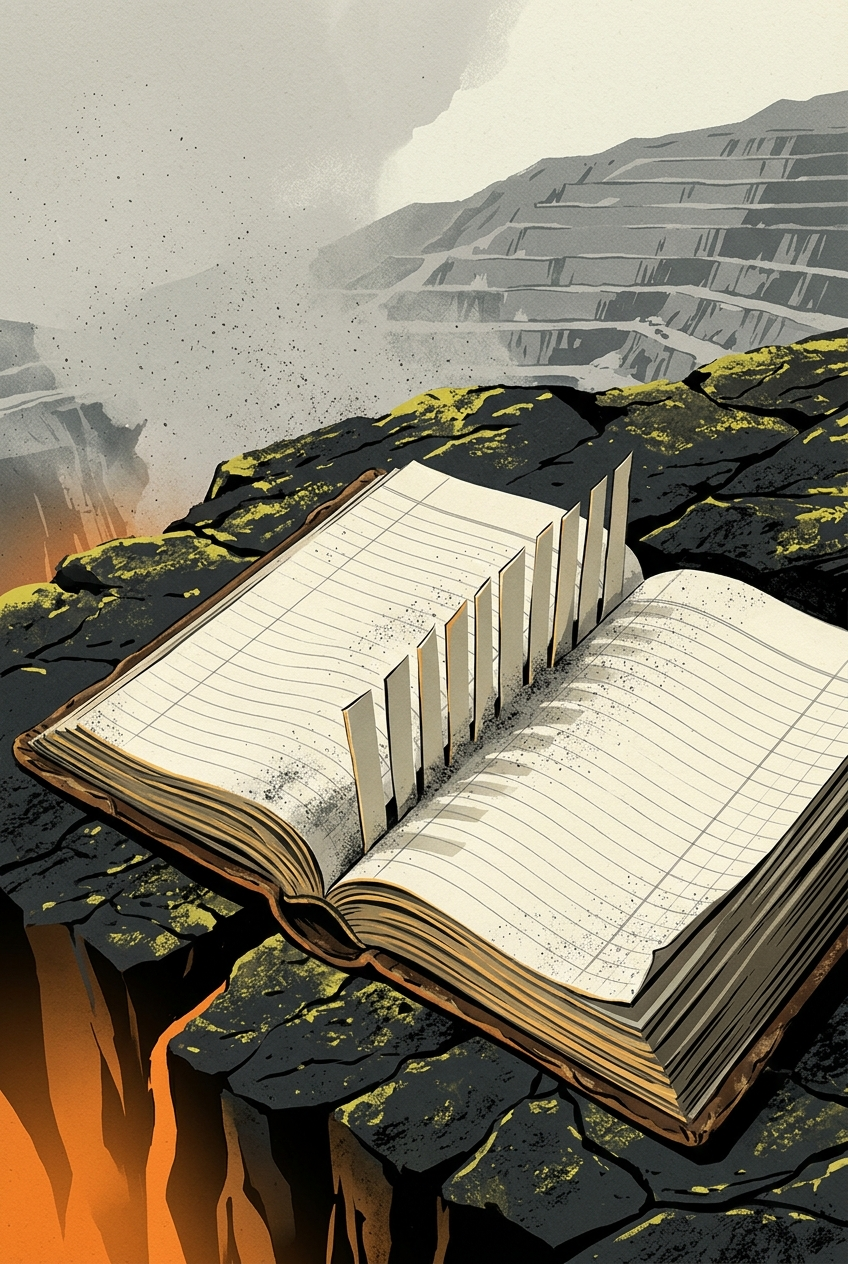
I have written eleven thousand obituaries and never once the phrase lost her battle with. Cancer is not a war. Dying is not a defeat.
Synopsis
June Halloran has run the obituary desk at the Ashaway Ledger alone for years when a bad voicemail and a 1998 decision to stop distinguishing Ashaway from Ashaway Township lead her to publish a careful, well-written death notice for the wrong Wendell Pike; the living one, a retired lock tender with a bait shop and a collections agency on his back, walks in not to complain but to say that nobody has ever written a whole paragraph about him, and a month later he brings her a paying customer. Over fourteen months June kills eleven people for three hundred dollars apiece and discovers that almost none of them want revenge for longer than a week, and that what they actually want is to hear themselves described accurately while they can still hear it, the exception being Corinne Wills, who asks to be made boring enough that nobody would drive four hours to check, and who is quietly asked after in January by a polite man in clean boots. The practice dies when Merricomb Media consolidates ten obituary desks into one hub with an automatic cross-check against the state vital records index, which lays June off and then rejects the real obituary of the real Wendell Pike as a duplicate record with no certificate behind it, so June spends nineteen hundred and eighty dollars of her severance on a full page, gives Wendell nine hundred and forty words, and sets a six-point correction box at the foot of it resurrecting ten of the eleven. She reads it at the graveside, gets as far as he is survived by, and is helped through the rest by men in the second row calling out the amounts they still owed him; she ends up writing obituaries for the living at sixty dollars a session, reading each one out loud once to the person it is about, which is the thing she could not do for her husband in 2011 and has been trying to fix ever since.
Survived By
Story
I have written eleven thousand obituaries and never once the phrase lost her battle with. Cancer is not a war. Dying is not a defeat. If you want your mother to have gone down swinging you can pay the Ashaway Ledger four hundred eighty dollars for the paid notice and print whatever you please, including the poem about the footprints. You will not get it out of me for free.
The free ones are mine. Four column inches, no photograph. I write them the way Pruitt taught me in 1984, standing at his elbow while he edited with a grease pencil: the name, the age, the town, what the person did with their hands, and who is left. Everything else is upholstery.
I say all this so that you understand that when I killed Wendell Pike, I did it well.
Here is how it happened. In 2019 the paper cut the obituary desk down to me, and me is a sixty-six-year-old woman with a legal pad. Funeral homes email. Families call the after-hours line and leave a message, and in the morning I sit with the headphones on and transcribe grief off a bad connection.
That Tuesday it was a woman with a small voice and a truck going past her. Pike. Wendell Pike. He was sixty-eight. Then a callback number that rang, both times I tried it, at the laundromat on Vine.
We used to distinguish between Ashaway and Ashaway Township. We stopped in 1998, when circulation folded the townships into one delivery zone and somebody in Columbus decided the datelines should match. So when I went into the morgue file for Pike, Wendell, I found exactly one, and he had kept the lock gates at the Ashaway lock and dam for thirty-one years, and he ran a bait shop out of a converted Sohio station on Route 7. I wrote four inches I was proud of. Thursday I put him in the paper.
The dead Wendell Pike was eighty-one and lived out past the reservoir.
The live one came into the office Friday at ten, holding the paper folded to the page the way men hold a paper when they have already read the thing forty times. Sixty-eight and built like a fire hydrant somebody left out through a few winters. Hearing aid in the one ear, nothing in the other.
I came out from behind the desk. There is a correction policy. It covers misspelled surnames and one memorable transposition involving a man's cause of death and his line of work. It does not cover a dead man standing at your counter in a windbreaker.
"You wrote this," he said.
"I did. Mr. Pike, I am so sorry."
"You got the lock right." He set his finger down on the column like he was holding it flat in a wind, and then he read out loud, slowly, the way a man reads who does not read much. "He held the gates through the flood of 1997 and did not come off the wall for four days." He looked up. "Who told you that?"
"You were in the paper in 1997. It's in the file."
"I never saw it."
"You were busy."
He laughed once, a sound like a chair being moved, and then he said the thing I have thought about nearly every day since.
"Nobody ever wrote a whole paragraph about me before."
I ran the correction the following Tuesday, two lines, page A2, under the fold. The Ledger regrets the error. Nobody reads corrections. I have known that for forty years and I had never once been grateful for it.
He came back in April with a man named Marcus Ott.
By then Wendell had told me, over coffee he did not ask permission to bring into the newsroom, what dying had done for him. Cavalry Portfolio stopped calling his sister. His ex-wife's attorney sent a card. A man he had owed eleven hundred dollars to since 2016 sent flowers to a funeral home that had no idea what to do with them. Wendell had ninety days of quiet for the first time in a decade, and he had spent some of it reading four column inches about himself.
"Marcus wants one," he said.
Marcus Ott was fifty-one and sold above-ground pools. He would not sit down. He stood by the window with his hands in his jacket and explained that he had a brother, Denny, in Wheeling, and that they had not spoken since their mother's funeral in 2013, and that he wanted Denny to read that he was dead.
"So he'll come," I said.
"So he'll feel something." Marcus watched a truck go by. "One time. Just once, I want him to sit down and feel it."
I told him no. Then I asked what he did with his hands.
That is the whole failure of my character, right there, in the order of those two sentences.
I wrote Marcus Ott four inches. Pools, thirty years of them, a wife who had left and a daughter who had not, a nephew he taught to swim in the deep end of a Sylvan 24 the summer the nephew was five. I ran him on a Thursday because Thursday is when people read.
Denny did not come. Denny did not call. Denny, as far as I have ever been able to determine, did not learn about it at all, because Denny had moved to Charleston in 2019 and did not take the Ledger, which is a thing I could have checked and did not, because I wanted to write it.
Marcus came in the next week to pay me anyway. He put three hundred dollars on the counter in twenties and stood there with the paper in his coat pocket, folded to the page.
"He's got a pool company," he said. "Denny. Did you know that? He's got the same business I got. We never once talked about it."
"I'm sorry it didn't work."
Marcus took the clipping out and looked at it and then he did the thing I had promised his brother would do. He stood in the front office of a newspaper and cried about a swimming lesson in 1994, and I stood four feet away and let him, because there is nothing to say and I have never once believed there was.
After that it was word of mouth, which in Ashaway means the bait shop.
Wendell set the price at three hundred and took a hundred for what he called referral. He had rules of his own that he had invented and considered binding. No insurance. Nothing notarized. Nobody who owed money to a person rather than a company, which he explained to me with real heat, sitting in my kitchen, as a matter of not being a bum about it. He kept the referrals in the same spiral notebook he kept the bait shop credit in, names down the left, amounts down the right, going back so far the first pages had gone the color of weak tea.
I added rules of my own. No photographs. No survivors listed who had not agreed to survive. And I wrote it or nobody did, which was less about ethics than about the fact that I had read what these people submitted when their actual relatives died, and I was not going to have my name on she never met a stranger.
Counting Marcus, there were eleven of them over fourteen months. A man who wanted out of a wedding party. A woman whose book club had become, in her words, a hostage situation. A retired pharmacist who told me the truth, which was that he simply wanted to know what it would say. I turned down four. One of the four was under federal indictment and had the poor judgment to mention it, and one was a man who wanted his wife to find out from the paper, and I put him out of the office with a firmness I had been saving up since about 1991.
I bought a chair with the money. I did not need a chair. It is in the front room and I have never sat in it.
Corinne Wills came in November, on a Thursday, twenty minutes before I put the page to bed.
She was thirty-eight and she kept her car keys in her fist the entire time she talked to me, and she stood where she could see the door, and she never once took her coat off. I did not ask. Wendell had not told me anything except a first name, which meant Wendell had understood not to.
"I need it to be plain," she said. "I need it to be so plain that nobody reads it twice."
"That's most of them."
"No." She shook her head. "Yours aren't. That's the problem. Yours make people want to know the person." She had done her homework, which almost nobody did. "I read the one about the woman who kept the score books for the softball league for forty years. I don't want that. I want the kind nobody finishes."
So I wrote her badly on purpose, and it was the hardest professional thing I have ever done. Corinne A. Wills, 38, of Ashaway, died Tuesday. She was employed in medical billing. Private services will be held at the convenience of the family. Nine lines. No mother, no father, no town of birth, nothing about her hands. A stone with the wrong name on it.
She read it standing at the counter, and then she folded it into eighths and put it in her coat and said, "Thank you. That's nobody."
I have thought a great deal since about what it takes to want that.
A man came to the counter in January asking after her. Polite, clean boots, said he was a cousin from out of state and had only just heard, and could he get a copy of the page, and was there a plot number anywhere. I told him our archive was down, which it has been since 2017, and that the funeral home listings are not something we keep. He thanked me and did not leave. He stood at the window and looked at the parking lot for a while, and asked whether many people had come to the service, and I said I would not know.
I have replayed that ninety seconds more often than I have replayed my own wedding.
The end of it arrived in a conference room in February, in the person of Tovah Grasse, who was thirty-one and had a title, Regional Content Director, and a laptop she opened before she sat down. Merricomb Media had bought the Ledger in 2022 along with nine other papers, and had spent the intervening period discovering that ten obituary desks are more expensive than one.
"So the exciting piece," Tovah said, "is that obits move to the Cleveland hub in April. Submission portal, standard template, and it cross-checks against the state vital records index before anything publishes. Which honestly is a compliance thing. You would not believe what gets published."
"I might," I said.
She gave me the smile people give you when they have decided your job is a hobby. Then she gave me fourteen weeks of severance for forty-one years and a cardboard box, and she was not unkind about it, which somehow was worse.
Six weeks. I told Wendell in the bait shop, over the counter, with the aerator going in the minnow tank.
He took it well. He said the run had been a good one. He said he was going to miss the paperwork, meaning the notebook, and then he made me stay for coffee that came out of a machine that had been in that Sohio station since it sold gasoline. On the wall behind him was the 1997 flood photograph, cut out of the paper and taped up, gone yellow, and it was the Ledger's photo, and he had told me he never saw it.
I did not say anything about that. It is the one piece of tact I can point to in this entire account.
He died on the ninth of March, on the floor behind that counter, sometime between five in the morning and when the first man came in for shiners. Heart. Delia found the shop open and the till untouched and her brother on the concrete with a scoop net still in his hand.
She called me. Not the funeral home. Me, at the desk, at ten past eight, and she said, "He said you'd know how to do it right."
I wrote it that morning. I wrote it in one pass, which almost never happens, and then I sat with it until noon changing four words, and then I put it in the queue.
The system rejected it at 12:04.
DUPLICATE RECORD. PIKE, WENDELL J., ASHAWAY OH. PUBLISHED 03/2025. NO CORRESPONDING VITAL RECORD ON FILE. FLAGGED FOR MANUAL REVIEW.
I called Cleveland. Cleveland called Tovah. Tovah came down the hall with her laptop against her chest and explained, standing up, that she could not override the flag, because overriding the flag meant creating a ticket, and the ticket would ask why the Ledger had published a death notice for a living man in March of 2025, and that question had an answer that neither of us wanted written down in a system.
"There's a paid notice," she said. "The family can absolutely still do a paid notice. That's a different pipeline."
The paid notice is four hundred eighty dollars for eight inches and it comes out of the family. Delia Pike is seventy-one and cleans two churches.
I have been in newspapers since I was twenty-five and I have never raised my voice in one. I did not raise it then either. I said thank you, and I went back to the desk, and I sat there with my hands flat on it for a while.
Then I walked down to advertising and bought a full page.
A full page in the Ashaway Ledger, Sunday edition, is nineteen hundred and eighty dollars, and the girl in advertising had to look it up twice because nobody had bought one since the hospital in 2021. I paid it out of the severance with a personal check, and she asked me what agency, and I said no agency, and she asked me what the ad was for, and I said it was for Wendell Pike.
They ran it March fifteenth. Page A5, the whole page, no border, no photograph.
I gave him nine hundred and forty words. That is roughly two hundred more than we gave the mayor.
I put the lock in it, all thirty-one years of it, the ice in '82 and the barge that lost steering in '89 and the four days in '97 with the gates. I put in that he could tell you what the river was going to do by what the swallows were doing, and that he was wrong about that maybe a third of the time, and that being wrong a third of the time about a river is a very good record. I put in the bait shop and the coffee machine and the fact that the minnow tank ran on an aerator he had rebuilt so many times that no original part of it remained. I put in the ex-wife, by name, because Delia said he would have wanted her in it, and I put in that the marriage lasted nine years and that he never said a word against her in public, which is not nothing, and which most people cannot manage.
And at the bottom I put the line that obituaries exist for.
He is survived by his sister, Delia Pike, of Ashaway, and by the sixty-one people who owed him money at the time of his death, none of whom he ever named.
I had the notebook in front of me when I wrote that. Delia brought it to me in a grocery bag. I counted the open accounts twice and then I put the notebook in the bag and gave it back to her and told her to burn it, and she said she would think about it, which is Delia.
At the foot of the page, under the obituary, in six-point type, boxed, I ran a correction.
CORRECTIONS. The following persons were reported deceased in these pages between March 2025 and February 2026. Each report was in error. The Ledger regrets it. Then ten names, alphabetical, no other information.
Ten. Not eleven.
I set that box myself, in the back shop, at eleven at night, with Ferris waiting on me to close the page, and I counted the names four times, because a correction is a thing a certain kind of man reads with his finger. Corinne Wills is not in it and will not be. If a girl in Cleveland ever runs a reconciliation against the state index and finds one death notice in Ashaway, Ohio, with no certificate behind it, I hope she is having a busy week.
Nobody at Merricomb ever said a word to me about that page. I have wondered whether anyone up there saw it. But I have known for forty years that nobody reads corrections, and I was, by then, extremely comfortable with the arrangement.
The funeral was the twenty-first, at Bethel Ridge, thirty-one people, more than I expected and fewer than he deserved, which is the standard result. Delia asked me to read it at the grave and I said I would rather not, and she looked at me the way women her age look at women my age, and I read it.
I got through the flood. I got through the swallows. I got to he is survived by and I stopped, and stood there in the wind off the reservoir with the page shaking in my hands, and a man in a Carhartt I had never seen before said, quiet, from the second row, "Eleven hundred dollars."
Somebody behind him said, "Two-forty."
It went around like that for maybe half a minute, men calling out amounts, and then it turned into laughing, and Delia put her hand over her mouth, and I finished the paragraph.
I wrote my husband's obituary in 2011. Frank. Four inches, because that is what I know how to do, and it is the only thing I have ever written that I could not fix. I have gone back to it perhaps a hundred times. Everything true about him is in it and none of it is him, and I did not understand why until Marcus Ott stood in my front office crying about a swimming pool.
You cannot write a good obituary about a person you cannot ask.
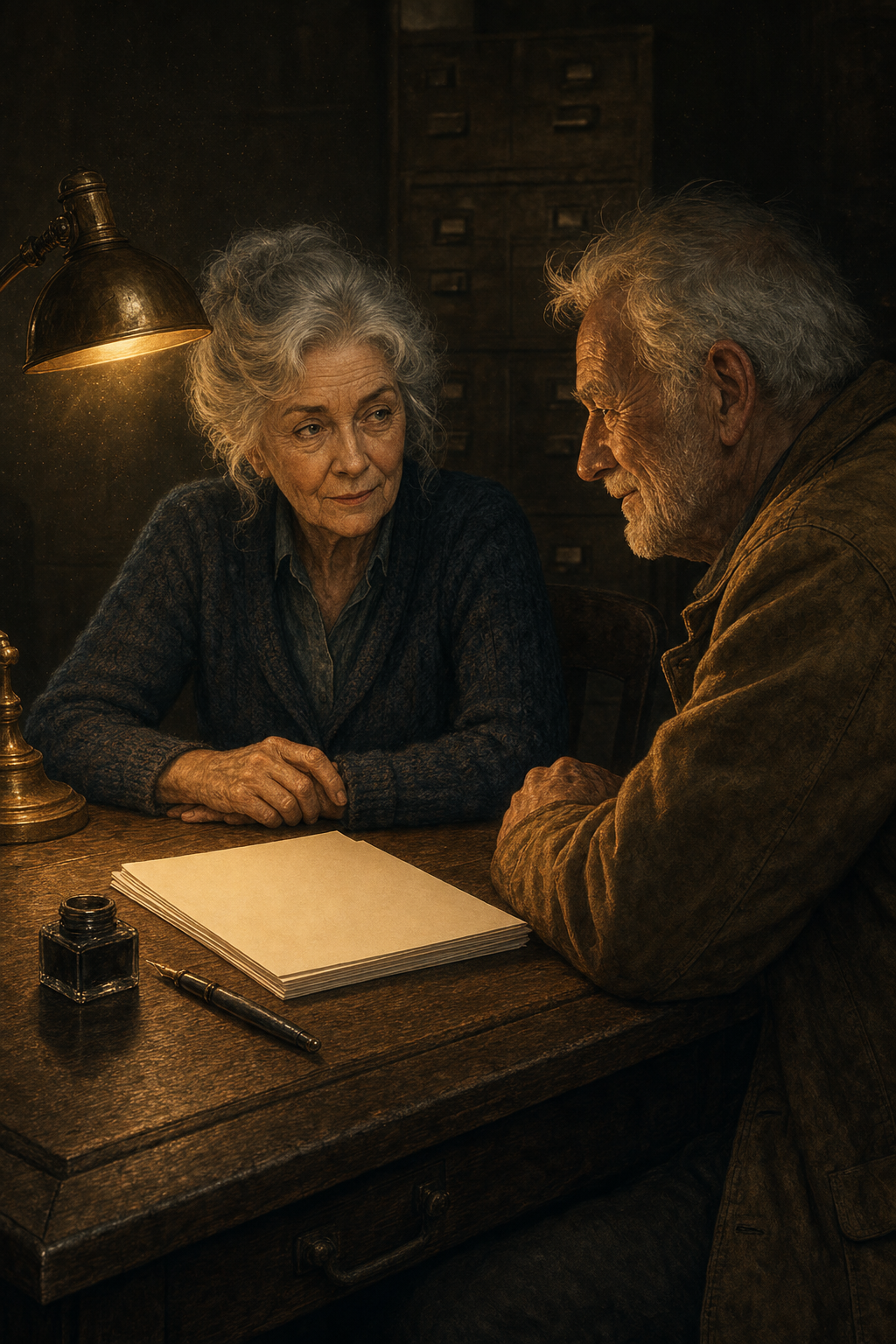
So that is the business now. Sixty dollars, and people come to the kitchen, and I sit them in the chair I bought with Wendell's money and I ask them questions for two hours. What their hands did. What they were wrong about. Who they carried. Then I write four inches, or eight, or nine hundred and forty if the person has it in them, and I print it on good paper and I read it out loud to them at the table, and then they take it home and do whatever they want with it. Some of them file it. One woman had hers framed, which I found embarrassing and did not say so. Most of them just wanted to hear it once.
I do not call it anything. Delia calls it the pre-funeral, which I have asked her to stop.
The postcard came in June, from a town in a state I am not going to write down, no signature, no return address, in handwriting I had seen once, on a check, in November.
You made me so boring. It's working.
I put it in the drawer with the tearsheet of page A5 and the notebook, which Delia did not burn and gave to me instead, and then I washed the cups, because Mrs. Vandergrift was coming at two.
She is eighty-nine and she wants to hear the part about the horses again.
More from Short Stories