Sworn Clean
Camber announced itself with a board on two posts, the letters redone that spring in a blue that had not been cheap. Doveh read it from a mile out across the pan and made her count. Nineteen roofs.
Synopsis
On the Pale, a dead sea basin crossed by the salt caravans, a town lives or dies by whether a guild witness will taste its well and sign it clean, and Doveh Amrit has been signing for twenty-two years with a palate that has begun, quietly and unmentionably, to fail her. Sent to the saltvine-growing town of Camber to certify a newly sunk shaft, she takes the three draws and finds the water genuinely, unarguably safe at the surface and the middle, and finds a man in it at the floor: the soapy tallow trace that witnesses call the salt of a person, carrying under it the copper of the tincture every witness drinks every morning of their working life. The town's own records and the guild almanac give her the name, Ottar Vance, struck from the roll six years earlier as a deserter, and the headman Bardu Sim gives her the rest without ever raising his voice — nine years of a witness calling a good well doubtful until Camber paid, and a final visit at which he offered to sign the town clean forever in exchange for the deed to its water. Six of them put saltvine in his tea and Bardu held the rope. Doveh's bind is that the water is clean and the ground is not: reporting it condemns a hundred and eighty people and lets the guild hang six men while burying the reason, and staying silent lets a murdered extortionist stay a deserter on the back page. She signs Camber clean and sworn, adds the near-forgotten witnessed sour clause that gives the town one year to open the old shaft, bury Ottar under a cut name, and file the death and its cause in the ledger at Ordell in their own words or lose certification forever — then drinks the entire floor draw standing, in front of all of them, so that no one is standing in it alone. On the road out she admits to her apprentice that the chalk went out of her palate a year ago and that this is precisely how Ottar Vance started, and hands her the reins.
Cover Art
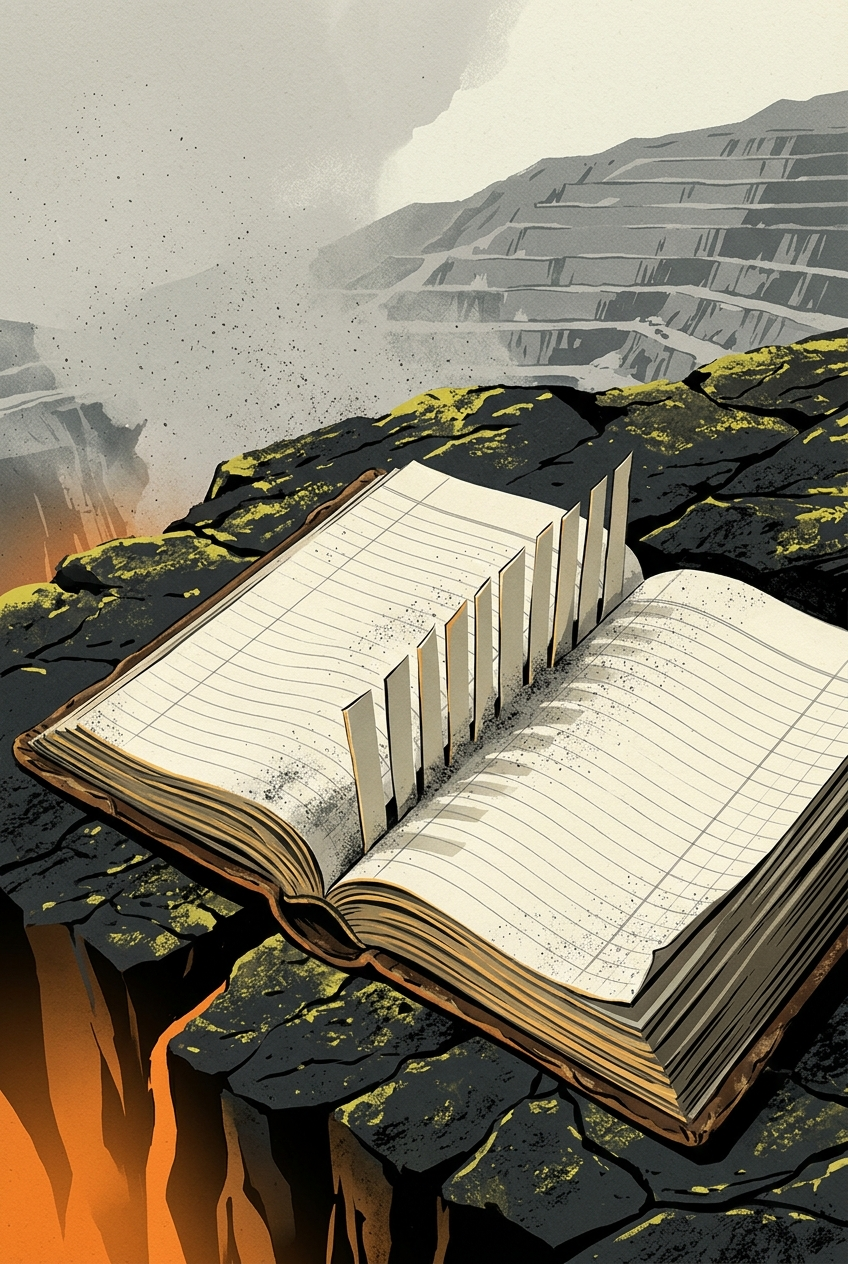
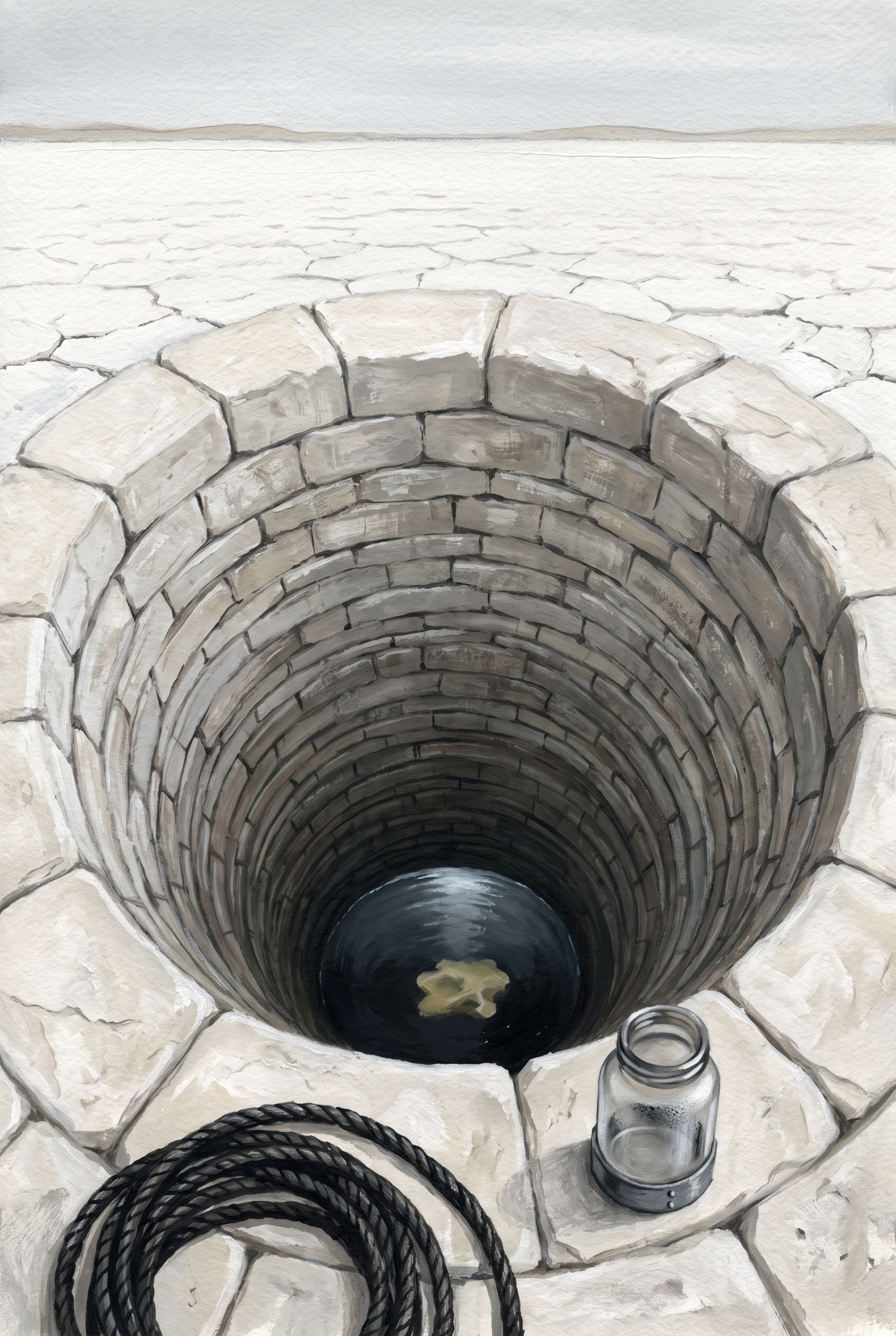
The cover is a steep top-down view into the well: bleached salt pan cracked into hexagonal plates, a ring of ashen limestone, the shaft receding through a dozen courses of masonry into darkness, and at the bottom a small disc of near-black water with a faint waxy bloom suspended just beneath the surface. A coil of tarred rope and the lead-collared glass sinker rest on the coping. Cold, desaturated, austere, no figure and no text.
Sworn Clean
Story
Camber announced itself with a board on two posts, the letters redone that spring in a blue that had not been cheap. Doveh read it from a mile out across the pan and made her count. Nineteen roofs. A press-house with a good tin chimney. Beyond the houses, four long beds of saltvine going silver where the wind combed it.
"How many people," she said.
Nea squinted. "Two hundred."
"Guess low next time. You'll be right more often, and they'll like you less. Both are useful."
The girl wrote something in her book. She wrote everything in her book, which Doveh had decided not to mind, since a witness who wrote nothing down was a witness who eventually invented things.
The salt under the wheels went from white to grey as they came in, which meant water somewhere near, which meant Camber had at least not lied about existing. Doveh flexed her hands against the reins until the knuckles agreed to work. Twenty-two years on the Pale, and her hands had gone before her back, and her tongue was going before either. That last one nobody could be told.
The chalk had left her the previous spring. She had drawn a cup at Ferrow and known there was gypsum in it the way you know a word you cannot pronounce. It was there. She could not reach it. She had signed Ferrow clean on the strength of the road she had come by, the color of the tailings, and the fact that the town's dogs were fat. She had been right. She had also been guessing, and both of those things were true at once and would go on being true.
A man came out to meet them with his hat already in his hand. Fifty, thick through the shoulders, a burn scar up one forearm from press-work. He said his name was Bardu Sim and that he had been headman eleven years and that they had been expecting her since the eighth.
"You'll have the room over the press-house," he said. "It's the quiet one."
"I'll have whichever one is nearest the well."
"That's the loud one."
"Then I'll be able to hear who goes to it at night."
He laughed like a man who had decided in advance to laugh at whatever she said, and led the horses in himself instead of calling a boy to do it.
The new shaft stood forty feet east of the old one, ringed in dressed stone, with a windlass that still smelled of the oil they had used to seat the bearings. The old well was capped under a slab with a stone trough set over it as a mounting block. That was ordinary. Half the towns on the Pale walked over their dead wells.
Doveh unrolled the kit on the coping while the town gathered at what they judged a respectful distance, which was near enough to hear.
Three draws. That was the whole of it, and every year some clerk at Ordell proposed a fourth, and every year the witnesses voted it down, because three was what a person could hold in the mouth in one morning and still tell apart.
The surface draw came up in the shallow dipper. She smelled it first, at the rim, then at the middle, then let it sit and warm a moment against her palm. Then a mouthful, held, moved, spat into the trough.
Short water. Two years underground, no more. It had come through red iron and something she chose to call chalk because the alternative was admitting she could not name it. Nothing in it that had ever been alive.
"Clean at the top," she said, and the crowd made the noise crowds make.
The middle draw she took at thirty feet with the sinker, a weighted glass jar that opened when you snapped the line. Longer water. Older. The iron gave way to a flat mineral plainness that meant the aquifer ran under limestone somewhere north, which agreed with the survey and agreed with the color of the spoil heap and agreed with everything, and she noted with private relief that she had not needed her tongue for any of it.
"Clean at the middle."
Then the floor draw, and the floor draw was where the trade lived.
She sent the sinker down until the line went slack, waited for the stir to settle, and snapped it. It came up cold enough to sweat the glass. She took it in and held it and did not swallow.
Soap.
Not soap the way lye is soap. Soap the way a tallow candle is soap, if you left the candle in a cellar for years and then licked the cellar wall. A round, dull, fatty sweetness sitting under the mineral like a coin under a rug.
Doveh had tasted it four times in twenty-two years. It had a name in the House and the name was the salt of a person, and no witness ever said it out loud in front of a town, because towns heard it as an accusation before they heard it as a finding.
She turned the mouthful once more. There was a second thing riding under the first, and by the time she had gone looking for it, the tip of her tongue had gone numb.
She spat.
"Well?" said Bardu Sim.
Doveh looked at the water in the trough running down toward the drain slot, at the nineteen roofs, at a girl of maybe six sitting on the mounting block over the old shaft with her heels knocking against the stone.
"Well," she said, "the floor's the floor. I want it again at dawn, before anyone pumps. It stratifies overnight. Anything I taste at midday has been stirred by the whole town's morning."
That was true. It was even good practice. It was not why she said it.
Bardu's hat came back into his hands. "The syndicate's man comes on the fourteenth."
"Then he'll come on the fourteenth and I'll have signed on the eleventh, or I won't have."
They fed her in the press-house because it was the only building with a table long enough for the whole of the town's opinion to sit at.
Camber grew saltvine. She had known that from the road, and she knew what it was worth: the caravans bought it dried and pressed into bricks, and drank it at the halts to make the nights on the pan shorter. Bitter as a debt. Every house on the Pale kept a tin of it and nobody admitted to needing it.
The tea came in a chipped pot with a cloth around the handle and Bardu's wife, Sera, poured it herself and watched Doveh's face while she drank, the way a woman watches when she has one good thing and it is a pot of tea.
It was very good. It was also saltvine, and after the second cup the tip of Doveh's tongue went pleasantly, familiarly numb, and she thought: there it is, old woman, that's your evening gone.
She thought it for one more breath.
Then she set the cup down and did not pick it up again, and Sera, who had been waiting to be praised, took the not-praising as a verdict on her tea, and Doveh let her, because the alternative was worse.
They talked around her the way towns do. The contract with the syndicate. The four halts between here and Muir. The cost of the new shaft, which had eaten eleven years of the press-house's profit and a loan against next season besides. A man down the table said that Ferrow had been signed in a single morning and Doveh said that Ferrow had eight hundred people and a river under it and could afford to be dull.
"How long does it take," Nea asked later, on the steps, "before you stop being able to hear what a town wants?"
"You never stop. You just stop letting it into your mouth."
"That's not an answer."
"No," said Doveh. "It's a technique."
The town's papers lived in a locked press in Bardu's front room, and Bardu unlocked it without being asked twice, which Doveh noted. Guilty men are helpful. So are innocent ones. It was one of the reasons the trade had settled on tasting rather than asking.
She went back through the certifications. A town kept every one, because a gap in the sequence was worth more to a syndicate lawyer than a fire.
Camber, signed clean, sixth of Ninth, year fourteen. Signed clean, year sixteen. Year eighteen. Year twenty. Year twenty-two. Each one in the same hand, a narrow upright script with a long tail on the g.
Then a gap of four years, and then Doveh's own hand, the first time she had come out this far east.
"Nea. The almanac."
The girl had it out of the pack before Doveh finished saying it, which was the best thing about her.
The House printed the roll each year: every witness, district, seniority, and the dead and the departed listed at the back in small type so that nobody would enjoy reading them.
Doveh found the narrow upright hand's owner in the eastern column. Vance, Ottar. Ordell. Districts eleven through fourteen. And in the back, four lines up from the bottom of a page: Vance, Ottar. Struck from the roll, year twenty-three. Desertion of post.
Six years.
She sat with the book open on her knees and the lamp guttering and let herself understand it in order, the way she would have made Nea do it.
A man is in the water. The floor draw says so, and the floor draw does not lie, though it can be misheard.
The water in that shaft is long water, and it comes through the same bed as the old capped well forty feet west, which the town abandoned for brackishness the same year, and the deep water in the new shaft has come past whatever is in the sump of the old one.
And the man in the water had copper in him.
Because that was the second thing under the soap, and she had been calling it saltvine because saltvine was in her own mouth at the time, and it was not saltvine. It was the grey. The chalk-and-copper tincture the House put in your hands the day you took the cup, that you drank every morning of your working life because it kept the palate honest and thinned the blood and did, over twenty years, a number of other things to you that the House did not print in the almanac. It sat in the fat. Everyone knew it sat in the fat. It was why witnesses were said to keep so well.
A witness was in Camber's water.
"You've gone grey," Nea said.
"I've been grey since you were in skirts."
"You know what I mean."
Doveh closed the almanac. "Go to bed."
"Doveh."
"Go to bed, and in the morning you're doing the floor draw and I'm not going to tell you what to look for, and if you ask me again I'll send you back to Ordell on the mail cart."
Dawn on the pan came up the color of weak tea. Nobody had pumped. Bardu had seen to that; he stood by the windlass with his arms folded and made sure of it, which meant he wanted the reading true, which meant something, though not yet what.
Nea sent the sinker down. Her hands shook on the snap and she got it anyway.
She took the mouthful. Doveh watched her face and made herself stand still.
The girl held it. Moved it. Went very carefully blank in a way that was not blankness at all but nineteen years of a face that had never had to hide anything learning in one second that it needed to.
She spat into the trough.
"Say it small," Doveh said.
"There's fat in it."
"Where?"
"Under the stone. After the stone. It comes back after you've swallowed and it shouldn't."
"And?"
Nea's tongue moved behind her lips. "My mouth's gone numb in front."
Doveh took the jar and drank what was left, all of it, the way you finish a letter you have already read.
Then she wiped her mouth and looked at Bardu Sim, who had not moved from the windlass, whose arms were still folded, who had known what was in his well for six years and had been waiting since the eighth of the month for somebody to come and tell him.
They walked out onto the pan because it was the only place in Camber where nobody could stand near enough to hear. The salt crust broke under their boots with a sound like biscuit.
"The old shaft," Doveh said.
"Yes."
"You capped it in year twenty-three and you told the district it went brackish."
"It did go brackish." He said it quickly and then heard himself and stopped walking. "After."
She waited. It was the whole of the trade, really. The tasting was two hours' work. The waiting was the rest.
"He came every second year," Bardu said. "Year fourteen he found the well doubtful."
"Was it?"
"No." Bardu looked out at the pan. "It never was. Not once in nine years. He'd take his three draws and stand there and say doubtful, and then he'd come and eat at my table, and my wife would pour him tea, and somewhere between the meat and the tea he'd tell me what would settle his mind."
"How much."
"First time, forty. Then sixty. Then a hundred, and the loan of the press for the season, and the year after that he wanted the press outright and my brother sold it to him for a paper price and bought it back at a real one." He said all of this to the horizon. "You want to know why we didn't write to Ordell."
"No."
That got him to turn around.
"I know why," Doveh said. "You'd have been writing to Ordell about a man whose signature was the only thing standing between your children and the road, and you'd have been asking Ordell to take his word or yours." She shrugged, one shoulder, which was as much as her back allowed. "I've been that word. I know exactly what it's worth."
Bardu Sim's jaw worked. "In year twenty-three he came in Fourth month instead of Ninth. He'd got thin. He said the House was going to move him west and he wanted something that would still be here after. He said he'd sign Camber clean for as long as he lived, every second year, no doubt in it, if we deeded him the well."
The wind came across the pan and neither of them said anything for a while.
"The well," Doveh said.
"Twenty families." Bardu's voice did not rise. That was the thing she remembered afterward. It never once rose. "He'd have been landlord of the water. My girls would have paid him for a bucket. Their children after that. He sat at the table where you sat and he drew it out on paper for us, what we'd pay by the head, and he'd worked it against the press-house takings, so he'd been at it a while."
"And you gave him tea."
"Sera gave him tea. Sera didn't know." He said that fast, too. Doveh let it stand. "She went to bed. Then six of us gave him tea."
"How much saltvine."
"I don't know. Enough. We didn't know how much was enough, we're not"—he stopped—"we grow it. We drink it. Nobody knows how much is enough."
"Who held the rope?"
"I did."
The sun was properly up now. Behind them, at the well, somebody had started the pump, and the sound came thin and regular across the salt.
"He was alive when he went down," Doveh said.
"I don't know."
"You know."
"I don't know," Bardu said, "and I have wanted to know for six years, and there is nobody in the world I could ask."
She signed at noon, in front of the whole town, because that was the form and the form existed for exactly this.
Nea held the book. Doveh wrote the district, the date, the three draws, the depth, the survey reference. Her writing had gone bad along with her hands and she took her time so it would be legible in fifty years.
Camber. Clean and sworn.
The town breathed out. Some of them were already turning to go back to work, because a clean well is the least interesting thing in the world to the people who live on it.
Then she wrote the second line, and Bardu Sim, who was near enough to read upside down, went the color of the pan.
Witnessed sour.
"Say it plainly," Doveh said, "for the ones who can't read from there. The water is clean. I've drunk the floor draw twice and I'd give it to a child. The ground is not clean, and Camber has one year to make it so, and if the ground isn't right by the ninth of Eighth next year then this signature lapses and no witness will re-sign it, because the sour clause carries and every one of us reads the last certificate before we take the first draw."
A man near the back said, "What's that mean, make it right?"
"It means you open the old shaft. You bring up what's in it. You bury it in ground and put a stone on it with a name cut in it." She let that sit. "And you send the name to the House at Ordell as a death in this district in year twenty-three, with the manner of it, and how, and by whom."
The silence went on long enough that she heard the saltvine moving in the beds.
"That'll hang us," Bardu said.
"It might."
"Then why."
"Because the alternative is I write it down instead of you." Doveh capped the ink. "And if I write it, the House hangs six men out of a town nobody's heard of for the murder of a witness, and the House buries the rest, and Ottar Vance stays on the back page as a deserter. He'd like that. That's a better ending than he's owed." She looked around at them. "You write it, and it goes in the ledger at Ordell with the reason attached, and the reason is that a man with a signature and no one above him found out what that was worth. They can't unwrite a ledger. I've tried."
Nobody moved.
"You've got a year," she said. "It's more than he gave you."
Then she picked up the long glass from the coping, the tall one she had drawn full at dawn and set in the shade, and she held it up so the town could see it was the floor draw and not the sweet water off the top.
The long measure. There is nothing in the statutes about it. Ordell has been trying to retire it since before Doveh was born, on the grounds that it is theater, which it is.
She drank the whole thing standing, in front of them, without stopping, the fat and the copper and the six-year-old cellar taste of a man she had never met going down her throat in front of a hundred and eighty people who all knew exactly what was in it.
It took a long time. Her hands shook near the end and she let them.
When she lowered the glass, Sera Sim was crying, and Bardu Sim was not, and neither of those told her anything at all.
"There," Doveh said. "Now we're all standing in it."
They left on the ninth. Bardu walked them out past the board with the expensive blue letters and did not say anything worth recording, and Doveh did not either, and both of them understood that they would find out in a year what kind of man he was.
Two miles onto the pan, Nea said, "You knew at midday. The first day."
"Mm."
"You could have not gone back for the dawn draw."
"I could have."
"Then why did you make me do it."
Doveh watched the road. Somewhere north under them the water ran through limestone, and it would keep running whether or not anyone was able to taste it, which was either a comfort or the opposite depending on the hour.
"Because the chalk's gone," she said.
Nea turned her head.
"Last spring. I can get iron and I can get salt and I can get a body, apparently, though I'd have taken another hour over it if you hadn't been standing there. But the chalk's gone, and what goes after the chalk is the mineral, and after that you're a woman in a grey coat with a cup on a chain, signing." She flexed her hands on the reins. "That's how he started. Ottar. Nobody starts out selling it. You start out unable to taste, and you find you can still say doubtful, and it turns out doubtful is worth more than clean to everyone except the people who have to drink it."
The cart went on. The salt went from grey to white.
"I've got two years," Doveh said. "Three if I'm careful and the districts stay east."
Nea got her book out, then thought better of it, and put it away again, and that was the first entirely correct thing she did as a witness.
"Districts eleven through fourteen," she said.
"That's right."
"That's a lot of towns."
"It is." Doveh handed her the reins, which she had never done, and worked her fingers, and looked at the road ahead, which went on for four days without a well on it. "Better start now, then. First one's Muir Halt, and I've never liked their middle draw."
More from Short Stories